Monday, 28 March 2016

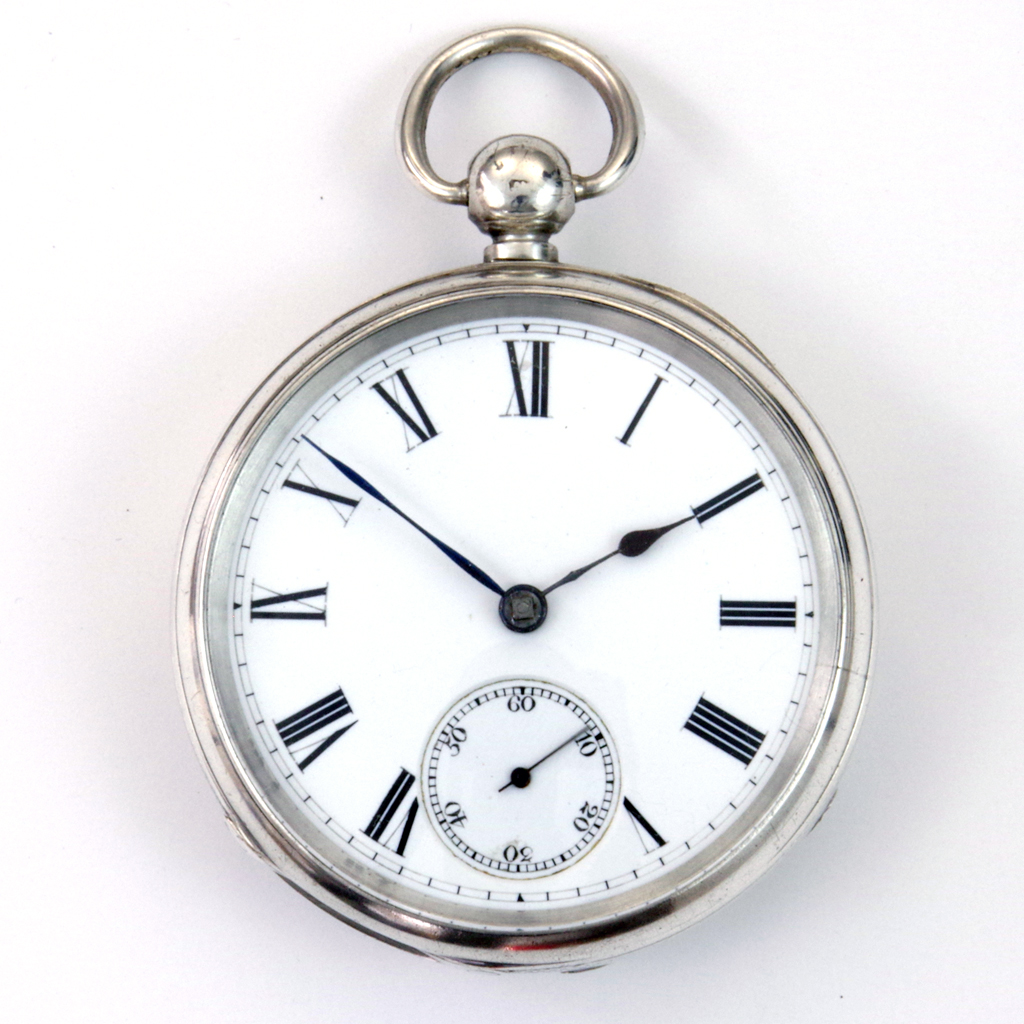
An unusual watch by Errington with some interesting patents.

Click on the picture for a larger view.
This watch by C.H. Errington of Coventry was made in 1895 shortly before the business was acquired by Williams, it incorporates two Errington patents:

One was for a mechanism to let down the mainspring using the steel screw head visible bottom centre of the picture, this moved a cam which withdrew the "click" (ratchet) allowing the mainspring to be let down in a controlled fashion using the crown before removing the movement from the case.

This was a useful feature as normal methods could be rather hit and miss with the potential to cause damage, at least to the inner end of the spring, if let down too quickly. This set up was retained on many Errington and later Williamson movements for ten of fifteen years by which time the movement was no longer in [volume?] production.

A second example from 1895, this one with 11 Jewels
and for W.E. Weeks of Ryde.
The second patent was for the unusual position of the regulator curb pins protruding through the balance cock, this worked well but gave no significant advantage and would have been difficult to use with a Breguet hairspring and so, probably to avoid having two types of balance cock it was discontinued after a very short time. This is only the second I have seen and a few years ago when I showed the first of these to the Coventry Watch Museum they had not seen one either.

However in this example [update Jan 2017: And two other examples found since], the design led to an error. For a balance in this position the hairspring leaves the balance cock termination in an anti-clockwise direction and would be terminated on the right hand side of the cock looking at it as in the picture to the right. It would then move through the regulator curb pins which would be suspended off of the regulator towards the top of this picture.

Because the curb pins are under the balance cock this hairspring has to be terminated on the left of the cock passing under it. This probably mislead whoever put on the F[ast] and S[low] markings because they are the wrong way round as if the hairspring was moving off clockwise. So if this watch runs fast you have to move the index to F, lengthening the hairspring, rather then towards S as would normally be the case.
C.H. Errington of Coventry for A Faller of London,
Sterling Silver, 1895.

Friday, 25 March 2016

Benson Watches of 1885

Click any picture for a larger view.
These clippings are from a broadsheet full page advert in the Illustrated London News of the 12th December 1885. It only shows the recently introduced keyset “Ludgate” watch although there are some interesting pointers to the rest of their range. From the snippet below we can see that they were selling watches for between two  guineas (£2 2s or £2.10) and £500, at this time an agricultural labourer’s wage was about £35 a year.


In terms of general buying power, £500 is equivalent to approximately £49,000 today and would have purchased quite a grand house. Unfortunately I don’t know what sort of watch that would have been but it may well have been a gold cased "complicated" watch such as a repeating chronograph.

The Ludgate was shown in 3 sizes, although more were available, and in silver ranged in price from £5.50 (£540 in todays money) for an open faced watch to £9.10 (£900) for a half hunter. Gold watches ranged from £12.60 (£1,200) to £29 (£2,800).

Advertising standards do not seem to have been of much concern. For instance the general description of the Ludgate claims that the watch is “jewelled throughout” when the watch actually has a maximum of 13 jewels. 17 or, arguable at the time, 15 jewels would be required for that, Waltham's 1877 model for example was being made in quantity with 15 jewels well before this date and I have seen a Rotherham Fusee from the 1870's with 15 jewels which would also have been made in some quantity.

They also claim the watch has “maintaining power” to continue the action during winding, this is rather misleading, a "going barrel" movement maintains power during winding without any special features, what they are probably trying to do is to avoid mentioning that the watch is a “going barrel” type rather than the much more expensive Fusee which was still common in the English market and generally (in UK) considered superior and which required an additional mechanism to provide maintaining power. The very cynical might also think that they were trying to imply the watch was a Fusee.

The “True chronometer” balance referred to was a cut compensating balance already in fairly widespread use, particularly in better American watches.


Top left section showing small (top) and medium size (bottom)

Top right section.
Bottom left section showing large sized watches.

Bottom right section.

Saturday, 19 March 2016

Sometimes you have to improvise, fixing a hunter case.

I recently acquired a rather nice Hunter cased watch, the main problem with it being the lid not opening when the crown was pushed. Taking it to pieces I found that the tube that goes around the winding stem to activate the opening on this type of watch was missing. And I did not have one long enough in the spares box.

Just as I was starting what promised to be a long internet search for a small quantity of metal tube with the right internal and external diameters I had a brain wave: To help them sink, salmon flies are sometime tied onto brass, copper or alloy tubes of about the required size, so a quick rummage through the fly tying box, the plastic liner pulled out of a tube, a few seconds on the lathe to shorten it (easier than sawing it and less likely to cause distortion) and I have a fully functional watch case! J
 
Now to do the movement.

Wednesday, 2 March 2016

An Old Elgin and a Very early Dennison case.

11J Model 1 Elgin 1873
I originally thought this watch was English but John Scott in Australia, my eagle eyed guru on American watches, suggested it was in fact an American Elgin - a make I rarely see, especial in this size and from this date both of which would be very rare in the UK.

Checking the Elgin production records showed that he was correct and that it is a fairly early size 18, model 1 grade 18, class 5 movement from c1873 and reputedly one of the best models they made. It has 11 jewels and a Swiss Lever escapement laid out tangentially as an English Lever and with an over-sprung cut compensating balance.

It winds clockwise from the back and is set from the front by using the key on the "hub" holding the hands.

The really interesting part however is the English double backed, triple hinged, silver case which is a rare and very early case by Dennison who came to dominate the English volume case making industry and was second to none in the field world wide.

Priestley's "bible" (i) on English watch cases reports that Dennison family records show the business started in late 1874 but it also shows that the ALD makers mark was entered on the register (presumably, not for the first time) on the 20th April 1876. The back lid of the case has the date letter used in 1875 and again in 1900 with the shield cartouche indicating 1875, the Birmingham Assay house mark with it is also in the shield for the 1875 date series.

However the lion silver mark on the back lid and the date and silver marks on the dust cover (the assay house mark is not required to be repeated but usually is) have the cartouche for the 1849 series used up to 1874/5.

So the case was certainly made within in the first 12-18 months of Dennisons move into case making and well before he joined with Alfred Wigley in 1879 after which the business took off.

But there is a very strong probability that it was made as the hallmark date sequence changed in early 1875 making this a case from the first few months of production.

It is even probable that the case was personally made by Dennison. This quote is from Priestley (i) showing what humble beginnings the company had, particularly when you consider that Dennison has previously been one of the founders of Waltham.
"Aaron started case making by using a pole lathe in the attic of his house at 27 Villa Rd, Handsworth, Birmingham".

Ref i: "A History and Register of Gold & Silver Watch Case Makers of England: 1720 - 1920" NAWCC 1994.


Tuesday, 1 March 2016

An unusual English Key Set Watch, 1900.

This post was in error, the watch turned out to be an early American watch by Elgan in a very rare case made by Dennison in his first year of operation as a case maker. The full story is in this subsequent post.


Sunday, 28 February 2016

Adventures with a Watchmakers Lathe - Part 2.

A week has gone by since my first post on this subject and the lathe is now operational.

The new motor, when it finally arrived, turned out to have tapped mounting holes underneath as well those at attaching it to the mounting plate for the Unimat lathe it was intended for, so mounting the motor was easier than expected.

The original mounting plate was retained to support the control box but underwent major surgery to get it out of the way.

The motor is on a 4 sided carrier of angled aluminium I had available and runs on two rails of the same. Holes are at 1” centres on the carrier and ¾” centres on the rails so there is plenty of room for adjustment fore and aft without having to change the height of the lathe. The adjustment is required so that the belt can be moved to each of the three wheels on the lathe, giving different speeds, to take up slack from stretch and to compensate for any errors in making the belt which is plastic, cut to length and then the ends melted and pressed together. It is important not to have the belt too tight which can damage bearings, too slack and the belt will slip.

The best arrangement is for the belt to slip only if you are too heavy handed with the lathe tool, protecting the motor and hopefully the tool and work piece.

I didn’t care for having the speed control changed every time it was switched off and also thought it would be a good idea to be able to turn it off in a hurry so I put added on/off switch with an emergency off button.

The motor gives all of the power (110W continuous 100 – 5,000 rpm) I will ever need (and more). I just need to pain the original mounting plate, get a better mains cable and some clamps to avoid pulling the cable from the switch box and its done.

8mm WW standard Collet
The second picture shows the lathe with a four jaw traditional lathe chuck and a cross-slide tool carrier. Both of these features are useful but the vast majority of work will be done with a hand held "graver" cutting tool and using an 8mm Collet (or "wire")chuck in the configuration of the first picture.

I had though of writing a piece on the benefits of the Collet chuck in watchmaking but it would have been a bit technical and I found this article on Wikipedia that covers the ground.

The following table is taken from that article:

"The collet's advantages over other chucks is that it combines all of the following traits into one chuck, a valuable combination for repetitive work:"
-ColletScroll chuckIndependent-jaw chuck
1. Fast chucking (unclamp one part, switch to a new part, re-clamp)ReliablyReliablyGenerally not
2. Self centeringReliablyReliablyNever
3. Strong clampingReliablyUsuallyReliably
4. Resistance against being jarred loose (untightened)ReliablyTo varying extentsUsually
5. Precise centering (run-out less than 0.005 in (0.13 mm) TIR and usually less than 0.001 in (0.025 mm))ReliablyNot reliablyReliably (but requires time and skill)

Click on "Lathes" under labels to the right of the page for other articles in the series.

Sunday, 21 February 2016

Adventures with a Watchmakers Lathe - Part 1.

NOS Balance staffs for a size
16 watch - these for a Moeris
are particularly simple ones!

As with all pictures here click on
 the image for a larger view
There are a few watchmaking repairs that can only be done with a lathe and similar tools, the most critical being the manufacture of replacement balance staffs. Whilst replacement staffs are available from New Old Stock (NOS) for most watches by Waltham and several of the Swiss makers such as Cyma/Tavannes and Revue (that is one reason I deal in those makes) it is becoming increasingly hard to find them and prices are correspondingly rising, also NOS staffs are not available for any English watch made pre WWII.

For sometime I have been contemplating buying the necessary equipment and investing a considerable amount of time learning how to use it - several weeks full time I suspect before usable staffs are produced -  I haven't used a lathe since my apprenticeship days which was rather a long time ago and that lathe was about 6 foot long.

Having bitten the bullet and decided to do it I have finally managed to buy a second hand lathe and whilst I am closed for business awaiting the new financial year and for the supply of watches to pick up I will be writing a few blog entries to chart progress and to describe key aspects of the lathes use.

The first problem is the cost of a lathe, a new fairly comprehensive (but not complete!) set up by Bergeon, a premium supplier of quality watch and jewellers tools, is currently £27,594 (plus cutting tools and other bits and pieces) so that is clearly out of the question, even a "budget" watchmakers lathe by "Star" to a basic specification and with no motor is £2,874 and would require quite a few extras to make is usable for making staffs.

My Pultra 10 Lathe after
a days worth of restoration.

So clearly second hand was the way to go, after several failed attempts I was very fortunate to acquire an excellent English lathe by Pultra probably made in the early 1950s and with a very good specification. I was particularly fortunate in that some one tried to "snipe" me with a bid in the last 10 seconds of the eBay auction and I won by 12 pence!

A couple of the collet chucks (more of which in a later post) need replacing at between £20 and £45 each new (depending on size) or £10 - £15 used and I may want a few more, but apart from that it has all of the pieces necessary, except a motor which the seller has yet to auction.

However I have decided to go with a new electronically controlled motor which is on order, it is not designed for this type of lathe so will need some work to mount it and the lathe onto a base board and to connect them up.

One interesting feature of watchmaking lathes in general is that they are operated very much like a wood turners lathe with the cutting tool hand held, this close up shows the tool rest (not in position in the picture - in use it would be closer to the centre line). This particular one is a premium "tip over" type which can be folded back to allow access to the work for measuring etc. and then tipped forward, back into position without having to reset its position.


The whole lathe is 10.5 inches long and the tool rest only an inch long so this is pretty small precision engineering!

It was missing a few, mainly non essential but nice to have things, most of which I have now sourced and hopefully they will all be here in a week or so.

So far the total cost is about £1.2k but small compared to £28k for a Bergeon!

Click on "Lathes" under labels to the right of the page for other articles in the series.