Showing posts with label Swiss. Show all posts

Tuesday, 16 October 2018

A rare and interesting Stauffer

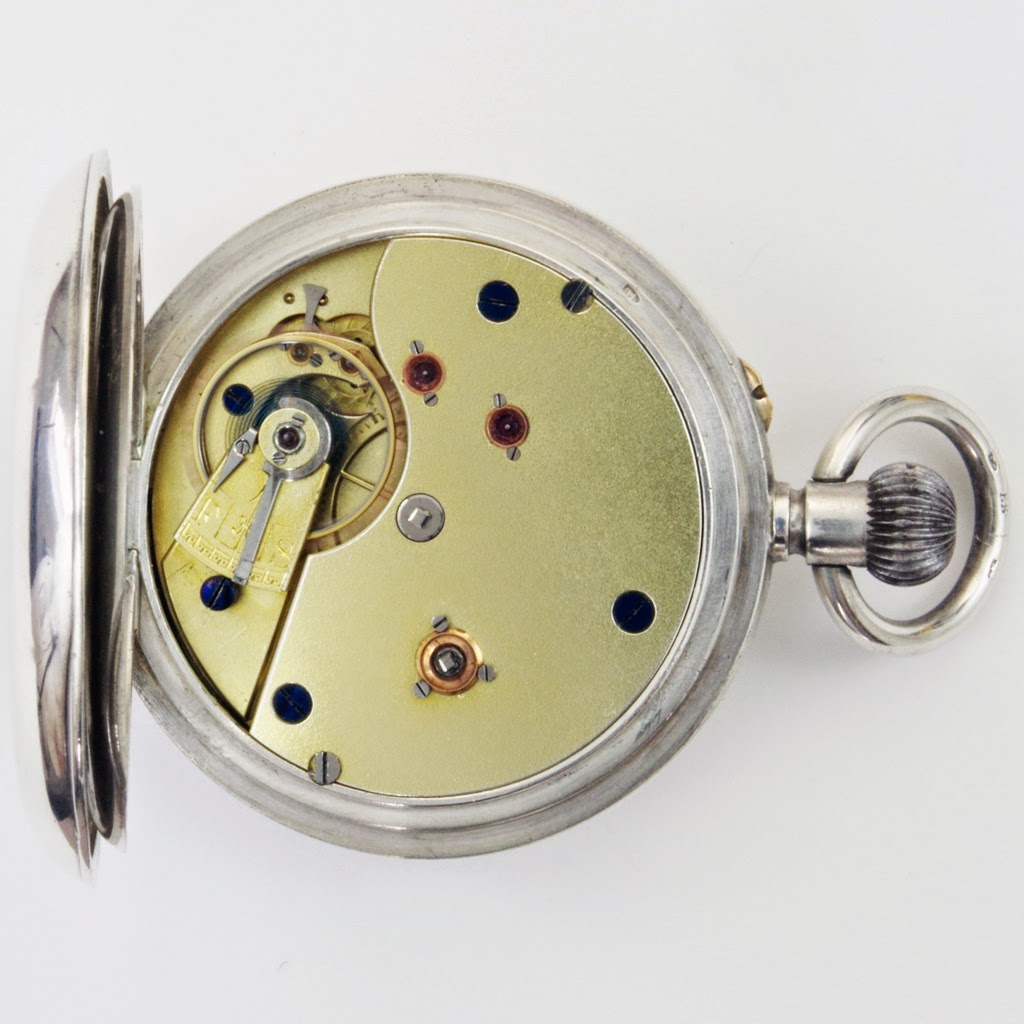
Size 14 Stauffer Pin Set watch, 15J c1900 or a bit earlier.

Apart from being pin set, at first glance this could mistaken for an Omega - I wonder who copied who? But it has a trade mark on it that shows it is by Stauffer of Switzerland.


and when the dial is off it is quite different.


The trade mark was registered in 1880 but had been in use from about 1835, it consists of two "S"'s and a very small "c" in a shield, not the later and far more common 3 triangles etc.

A feature I have not seen before is the way the Banking is adjusted, by far the most sensitive and precise I have seen but you do need to take the balance off to make an adjustment to the one on the inside:


It gets really interesting when you look at the dust cover where is says "Kew Certificated"

A Long case clock by W Harrison of
Hexham c 1825 and insert the dial from
a Coventry made chronograph 1882 by
W.E. Harrison Stockton-On-Tees. 
and "Harrison and Son, Darlington.

Kew (Later the National Physical Laboratory) was the standards agency for watches and clocks, was responsible for certifying chronometers and ran what was effectively a competition for top quality watches. Although certainly not a chronometer this is a good quality watch from around 1900.

Harrison was one of a widespread watch and clock making family in the North East of England, they are most probably descendants of the Harrison of the Longitude prize who came from the area. It is very difficult to work out family relationships from the clockmaking records as there were a lot of them about in the 19th century and they kept moving about.

The last record I can find of Harrison in Darlington is 1905 but they might have continued for sometime after and not been recorded in Loomes or elsewhere.


English Fusee leaver watch signed Harrison & Son Darlington 1877.


Monday, 20 July 2015

Naming Confusion!

Here is a good example of why attribution can be a problem.

This good quality 16 jewel watch is signed by well known makers & retailers Kendal and Dent - Dent made the clock that drives "Big Ben". But the movement is signed DF&C for Dimier Freres et Cie part of a long established Swiss watch making dynasty, but in this case the movement was actually made by Review Thommen, probably for the London branch of Dimier who were major watch importers.

Friday, 29 May 2015

Revue Thommen Movements

The range of size 16 movements by Revue Thommen appears to be very large, but all it not quite as it seems.

Some Revue Thommen Movements - Click to enlarge.
 
These movement look fairly different, in fact apart from materials (and the gilt ones were also made with the nickel finish and vice-versa) they are essentially the same. Shown are some hunter and open faced versions but all variants were available as either.

The winding / setting mechanism, barrel, gear train and lever pallet are exactly the same (for watches made at about the same time) and for setting can have, without modification, a long winding stem as shown in the two centre examples or a short one for cases with a captive crown and stem. The balance assembly on all of these movements may be either  over-sprung or Breguet with either a cut compensating balance or a screwed balance (with Elenvar spring). The number of jewels can be varied and a micro adjusted used instead of the standard index for further variation.

The top plates and cocks are clearly different but the main body of the movement is the same except for being drilled differently to take the two studs and between 1 and 4 screws used to locate and secure each cock and plate.


Wednesday, 8 April 2015

Imitation is the sincerest form of flattery: A Swiss 17J Half Hunter c 1897.


But in the case of this Swiss watch the unknown maker should have been more confident and signed the watch. It  is the best made and finished Swiss watch I have come across, better I think than the Labrador by Louis Brandt and Frère / Omega  and at least as good as the early Rotherham it rather looks like. (Sorry Coventry Watch Museum  J also on Facebook ).

The movement was clearly made for the English market having the classic Rotherham shape, Fast and Slow markings without the French equivalent (A & R) and a true English Lever Escapement. It has 17 jewels, 15 plus cap jewels on the escape, and they are all screw set on the top  and three are on the face plate.
The Breguet sprung cut compensating balance has, apart from the timing screws which are steel to  gives finer control of the timing, gold screws which is not common in a Swiss watch. It also has a double roller and a functioning Geneva gear to control mainspring pressure.
The setting gear is particularly impressive with every piece very well finished.
 

Sunday, 24 August 2014

What's common? Standardisation in the Swiss industry.


Well, you have probably guessed that they are by the same maker and you would be right, they are all by Tavannes, the two on the left were made within a few weeks of each other probably in 1922, the one on the right for Benson in 1936.

But there is a bit more too it than that. By the time these movements were made the Swiss had gone a long way down the path of standardisation. Apart from the obvious differences in the top plate / cock / bridge design and the additional screw holes etc in the face plate to accommodate them, these three movements are, except also for the type and quality of the finish, essentially the same with all of the wheels, the setting mechanism, the balance staffs, etc  interchangeable when new.

The  movement in the centre arrived with a very bent centre wheel caused by someone pressing the barrel against the wheel when taking the barrel out, so rather than trying to straighten it I repaired the movement by taking a centre wheel from a scrapped Benson (Tavannes) from c 1935, like the one on the right, which fitted perfectly and required only a trivial adjustment to the cannon pinion to get it all working. A small worn part in the setting mechanism was also replaced from the same scrapped movement. If only old English movements could be repaired as easily!

The fact that the two left hand movements have serial numbers in excess of 13 million also gives an indication of the scale of manufacture that the Swiss companies were now achieving; in 1925 the Swiss [population c 3.8 million] were making about 19 million watches a year whereas the USA [population c 120 million] were making c 9 million and the English industry was essentially dead.

 Scale and lagging behind in standardisation, two of the reasons why the English watch trade went belly up.

Thursday, 23 January 2014

Silver Hunters

Silver Hunters and Half Hunters are becoming increasingly hard to get and its been a while since I got any in but here are two new arrivals. Top: a very nice 7J Waltham 1908 model, 1919. Below: Another good J.W. Benson Half Hunter by Tavannes, 1913. Both in Dennison Silver cases.

Friday, 6 December 2013

Omega c1927

And here is another cracking silver case, this time containing a very good size 12 Omega 15J from c1927.