Showing posts with label Waltham S12. Show all posts

Saturday, 2 January 2016

The Safety Pinion (Fogg's patent)

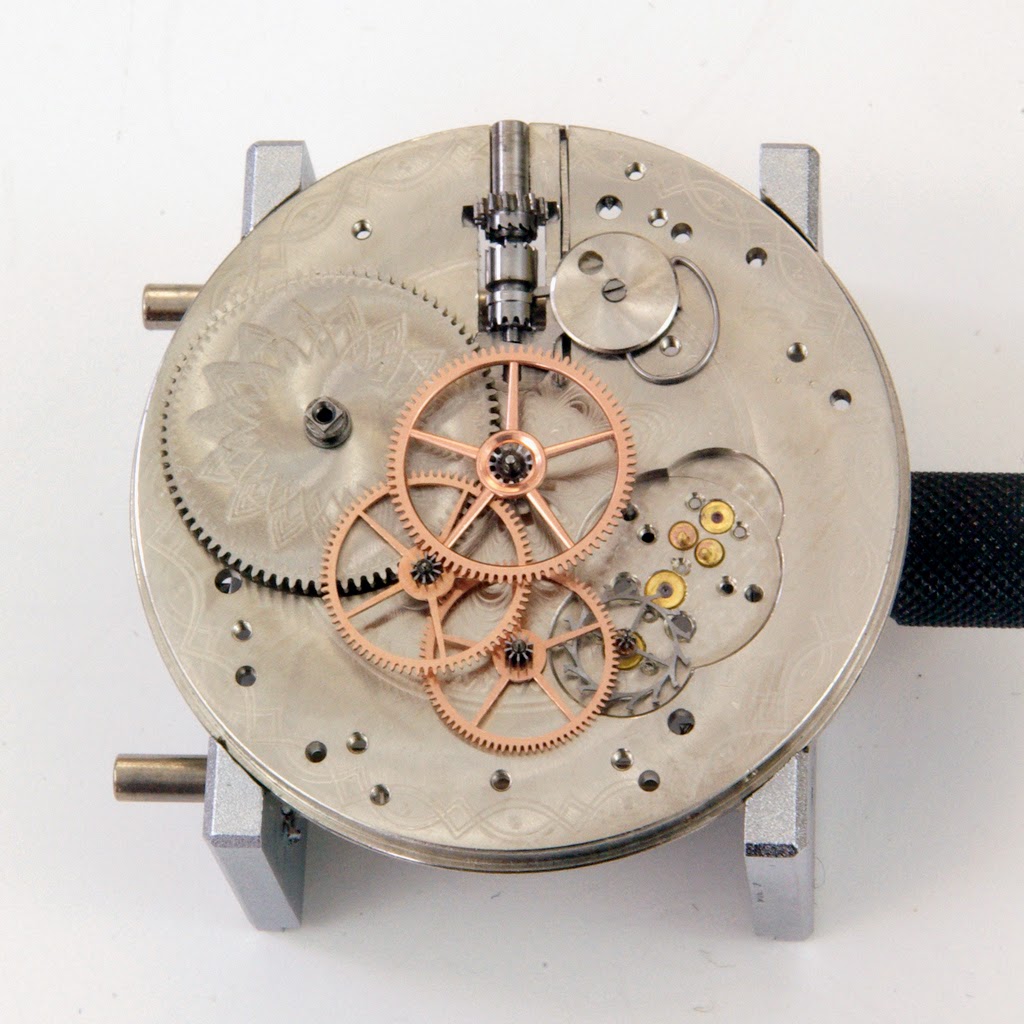
A Reversing Pinion prior to assembly.
The Safety Pinion originated in 1865 when it was usually described as "Fogg's patent", it was intended to avoid damage to the movement in the event of a mainspring breakage, the spring being let down too quickly during maintenance or following failure of the click (ratchet stopping the mainspring arbor from "winding down" and forcing the barrel to move instead).

The problem was that with the very strong springs required at the time the backlash after a failure would go through the train and potentially break weaker parts, mainly I suspect the lever pallet and pallet jewels.

The solution is quite ingenious. Instead of the centre wheel pinion being fixed to the wheel / staff it is screwed on. In normal use the gear teeth on the mainspring barrel bear against the pinion and keep it screwed down.
A "Reversing Pinion" during assembly
but not yet screwed on.

If the pressure is suddenly reversed the pinion unscrews and no reverse power is applied to the rest of the movement.
This solution was initial used by Waltham and then by Elgin who presumably licenced it, but by the 1890's, if not earlier, the concept was more widely used in the USA (the example shown is from a Seth Thomas of 1896) and by a number of the larger makers in England including The Lancashire Watch Company and William Ehrhardt.

Waltham later introduced the "Safety Barrel" to address the same problem but as the amount of power a watch required reduce with the introduction of lighter movements, improved manufacturing tolerances and more jewelling, there was no longer a real need and safety pinions were discontinued.

Saturday, 29 March 2014

Waltham Colonial Riverside, 21J, 1936

Another excellent size 12 Waltham, this time a "Colonial Riverside" with 21 Jewels including the mainspring barrel.

The Swiss Lever escapement has a Breguet Sprung screwed balance with double roller, the hairspring appears to be elenvar to reduce temperature variation and the movement is adjusted for temperature. The serial number dates it to 1936.

The Colonial movement is particularly slim and in its case is only 0.4" / 1cm thick.

A perfect watch to wear with evening dress or military mess dress but equally suitable for day to day wear.

Saturday, 22 March 2014

A very rare Waltham 1894-Riverside Maximus, 21J 1903/4

In a previous post I described the Waltham S16 Riverside Maximus and mentioned that the grade name was also used on premium grades in other sizes. Here is one in size 12 and it is pretty rare.

The Waltham production records show that about three and a quarter million 1894 models were made of which about 83 thousand were "Riverside" grades but only 10,063 Riverside Maximus grades were made of all types - and that number will include rejects and movements planned to be made but not.

Of these only 2,801 were recorded as Open Faced 21Jewel movements the rest being Hunters or of different jewel count.

The general design is very close to the larger 1899 & 1908 models which followed and has moved away from the captive winding stem of the 1888 model. It has a Swiss Lever escapement with a Breguet  sprung cut compensating balance.

This grade also has a double roller, micro adjuster and steel escape wheel as found in railroad grade watches of the period.

Apart from the escape wheel the train wheels are gold and the top plate jewels are screw set in gold mountings. There are diamond cap jewels on the escape wheel and the Balance.

This example has a rare dial signed by Bailey, Banks, Biddle Co. Philadelphia - a very prestigious jewellery maker and retailer.

The case is by the Illinois Watch Case Company of Elgin and is rolled gold.

More pictures can be found via this page of my web site.