 |
| Waltham 1899-Cronometro Victoria, hunter movement, 1905 |

Showing posts with label Waltham S16. Show all posts
Showing posts with label Waltham S16. Show all posts
Friday, 15 March 2019
Waltham 1899-Cronometro Victoria
R.R. Fogel of New York had an agreement to sell Waltham watches into South American markets, the special order movements were styled "Cronometro" and came from various Waltham product lines and grades. The 1899 model "Victoria" is a 15 jewel movement similar to the -620. The movements were often recorded in production records simply as "Export" and could be in mixed runs so it is not known how many were made. But they are rare in UK.

Thursday, 14 March 2019
Waltham 1899-618
 |
| Waltham 1899-618, 15J, 1904 |

I have only seen a couple -618's, the open faced version above and the Hunter below. It is essentially a 15 jewelled version of the Traveler. The 1908 equivalent appears to be the "Marquis" which is more common.
 |
| Waltham 1899-618, 15J Half Hunter, 1907 |
Wednesday, 28 March 2018
Waltham “own label” movements.
Waltham “own label” movements are very rare in UK – I have
only seen them for Russell of Liverpool and Preston’s of Bolton, but they are somewhat more common in the USA. They come in two varieties. The first have different
specifications to mainstream models, such as this 1908-641 branded the Preston’s
senior which appears to be a 1908-PSB with the addition of a double roller.
 |
| Waltham 1908-635 The "Russell Model" |
The second more common own label, is a standard model with
engraving added to brand them as “own Label" The Preston's junior is of this type as is the Russell model above which includes the Waltham name on the movement and this 1899-630 marked for jewellers Harry A Dillon of Gloversville New York but without the Waltham name although in this case Waltham is on the dial.


Wednesday, 8 November 2017
A Pocket Watch for use on Nuclear Submarines.


As confirmed by the catalogue number it was originally supplied to the Royal Navy during WWII with luminous hands and face, it was retained at the end of the war, unlike around two million pounds worth of surplus watches and clocks that were sold off.

The American screw backed case is in base metal case and was made by the Star Watch Case Company, it is stamped with the military catalogue number, the Military property mark, the service allocated serial number and "Non-Lum" as described above.
Thursday, 13 April 2017
Waltham 1908-642
 |
| Waltham 1908-642 from 1918. |
A fairly rare movement with only 3,000 made in two runs, as an intermediate grade between the -640 and -645, it appears to be a 1908-640 but adjusted to 5 positions rather than 3 and without some of the decoration of the -645. The two runs were mixed Lever Set Railroad watches and Pendant Set Railroad Grade. I have had 3 of these, all pendant set and it is possible that the Pendant set versions were for the UK where Lever Set watches were not popular.
The 17 jewel movement is also adjusted for temperature and possibly isochronism, it has a Swiss lever escapement with a steel escape, Breguet sprung cut compensating balance, double roller and screw micro adjustment.
Saturday, 23 April 2016
Waltham 1908-Riverside.
 |
| Waltham 1908-Riverside, 1908 |
Wednesday, 14 October 2015
A rare pair of papers.
 |
| click the picture for a larger view |
The papers were used for advertising and would have been put in by sellers or repairers and occasionally you find a watch with a stack of them but usually they are glued together, to the case and / or are falling to pieces. Both of these are original to the watch and have the same retailers names as are shown on the watch faces.
The blue one is on a Rotherham from 1901 retailed by Hoefler of Devonport. The watch itself is something rather special - watch this space!
The red paper is on a Waltham 1908-610 half hunter sold by Harral of Barnsley, it has the serial number of the movement on it and is dated 11 years after the watch was made so presumably they were warranting a repair or they had bought back the watch and had resold it.
The red paper is on a Waltham 1908-610 half hunter sold by Harral of Barnsley, it has the serial number of the movement on it and is dated 11 years after the watch was made so presumably they were warranting a repair or they had bought back the watch and had resold it.
Friday, 13 March 2015
An early and rare Waltham Traveler

It has a split plate movement with 11 jewels, screw set apart from the lever. The Swiss lever escapement has a cut compensated balance with Breguet Spring. The serial number dates it to 1899.
The half hunter "Empress" grade case is in Filled Gold and is by the Canadian factory of the American Watch Case Company - locating manufacturing operations overseas to save tax is not a new phenomenon!
Monday, 2 March 2015
A rare "Own label" Waltham 1908-641 model:
.JPG)
It is signed "Preston Senior, Especially made for Prestons Ltd, Bolton, By Waltham Watch Co, Waltham U.S.A.".
I have also seen 1908-635's branded for Thos Russell of Liverpool and a lower grade, probably a 15J branded the "Preston Junior". A couple of others I know are now with a collector in Australia.
Wednesday, 3 December 2014
An interesting watch case


This high end size 16 Waltham has an interesting watch case by the Philadelphia Watch Case Co.
The main body is either filled or rolled gold, the bezel and back are in American "Sterling" silver with the back inlayed with yellow, green and rose gold.
Click on the image for a larger view.
Thursday, 6 November 2014
An early Ehrhardt crown set watch based on a Waltham idea.
.JPG)
It is an early (for an English Watch) crown negative, pull to set, movement when most English keyless watches were pin set.
It is laid out as an English Lever with a Swiss style club tooth escape wheel and lever, again this was an early adoption by Ehrhardt as a half way house to the full Swiss Lever.
Saturday, 25 October 2014
Naughty Mr Ehrhardt.
.JPG)
Ehrhardt. had ripped off the design of the shifting sleeve setting mechanism from the Waltham 1899/1908 models. They are in fact identical and to fix this watch I used a small piece part from a Waltham.
Not that it did them much good as they stopped manufacturing not long after this example was made whilst Waltham continued making pocket watches until just after WWII and wrist watches until 1957.
Thursday, 18 September 2014
Waltham 1899 Riverside Maximus.
Here at last is a Riverside Maximus, in fact two of them! Except for a few specials and limited editions, the Premier Maximus (think £20k++ in a London store) and the rare American Watch Co Bridge model, this is the highest grade of watch made by Waltham.
Waltham developed the 1899 Vanguard for railroad use, although many were not used as such, the Riverside Maximus with essentially the same mechanicals was designed purely for the luxury goods market. Production was small with only 13,800 made (another source shows 14,600) of which 10,900 had 23 Jewels (rather than 21) and 7,050 were open faced with 23 jewels.
Production runs were small ranging from 100 to occasionally 500, the older of these two watches is from the third run of 23 jewelled open faced movements. The movement plates are damascened to the back whilst the face pate has a jewelled finish.
The movement has a gold train, except for the escape wheel which is steel. Top plate jewels are set in raised gold mounts, the barrel is jewelled and there are four diamond cap jewels to the balance and escape with the rest being "fine ruby and sapphires".
Like the Vanguard it is adjusted to temperature, isochronism and five positions and it has micro adjustment to the Breguet sprung cut compensating balance with a double roller
The three piece dials have lettering in a font reserved for the Maximus, the Roman dial on the left is particularly rare with one selling recently for almost $300.
 |
| Left: Waltham 1899 Riverside Maximus, 23J, 1901 and right 1902. Click any image for a larger view. |
 |
| The 1902 example opened up. |
Production runs were small ranging from 100 to occasionally 500, the older of these two watches is from the third run of 23 jewelled open faced movements. The movement plates are damascened to the back whilst the face pate has a jewelled finish.
Like the Vanguard it is adjusted to temperature, isochronism and five positions and it has micro adjustment to the Breguet sprung cut compensating balance with a double roller
The three piece dials have lettering in a font reserved for the Maximus, the Roman dial on the left is particularly rare with one selling recently for almost $300.
Monday, 23 June 2014
The Waltham 1899-174 & other 11 jewel watches that try to look more than they are.
.JPG) |
| Waltham 1899-174, 11J 1902 |
But the interesting thing is how the jewels are laid out. After the basic seven jewels the most efficient layout is for them to be in pairs top and bottom of each staff and put where they will do most to reduce friction and the impact of that friction on the watch. That will be the staffs moving fastest which happily in a watch are also the ones with the most gearing effect.
So with four additional jewels these would normally be set in pairs on the lever pallet and escape wheel or, as favoured by a number of quality English makers, on the escape and seconds wheel. But on this movement the extra jewels are lined up on the top plate, why?
.JPG) |
| Cyma 10J for Thos Russell |
This is so that the buyer (or perhaps a seller?) can show off the watch and claim it has 15 jewels!
Others went further, the second movement shown has ten jewels in the presumed hope that no one will notice that the top pivot of the lever pallet, small and hidden under the balance, is not jewelled.
Friday, 21 March 2014
Waltham 1908-Royal Lever Set Variant.
.JPG)
A total of around seventy-five thousand 1899 & 1908 Royal grade movements were made but they are normally pendant set. The production records show that only five production runs totalling 4,000 movements included some open faced lever set variants, what the proportion was is not known, all are 1908 models dating from 1919 or later.
Apart from the lever setting the movement is the same as the 1908 pendant set version.
Tuesday, 18 March 2014
Waltham 1899-Royal & 1908-Royal
.JPG)
The 1899 and 1908 versions are essentially the same and so can be treated together.
.JPG) These were one of the highest grades before getting to the Railroad grades and their "civilianised" variants. The damascened nickel movement has 17 Jewels, a Swiss lever escapement with a Breguet Sprung cut compensating balance with micro adjuster and is adjusted for temperature and three positions. The top jewels are screw set in gold mountings and it has a gold centre wheel.
These were one of the highest grades before getting to the Railroad grades and their "civilianised" variants. The damascened nickel movement has 17 Jewels, a Swiss lever escapement with a Breguet Sprung cut compensating balance with micro adjuster and is adjusted for temperature and three positions. The top jewels are screw set in gold mountings and it has a gold centre wheel.The example shown, which has just been restored, has an unusual 3 piece plain dial and which probably originally had a retailers name applied, (see related posts on watch face construction and on blank dials).
Thursday, 6 March 2014
How come my 30 hour watch runs for > 40 hours? Or: Management of Isochronism in watches.
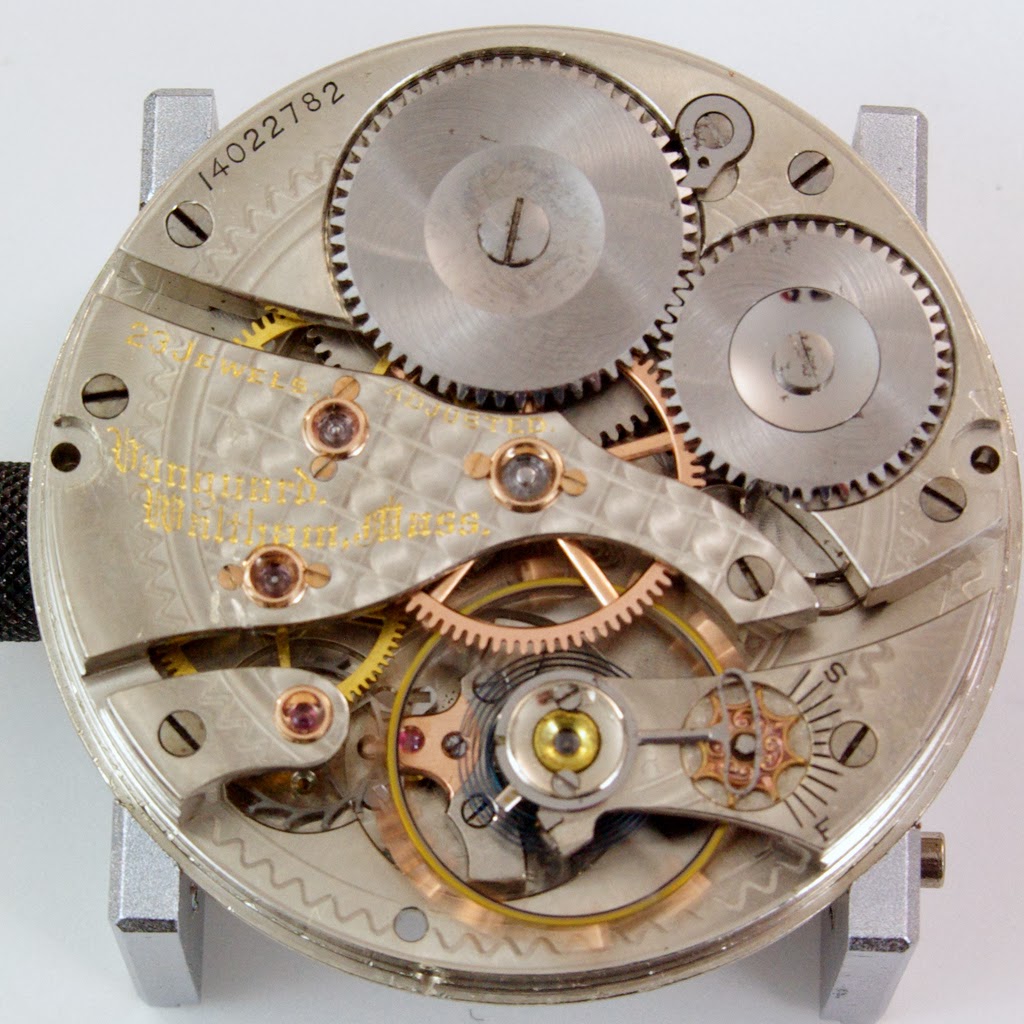 |
| Waltham 1899-Vanguard 23J click on the images for a larger view |
Most pocket watches are designed to run for 30 hours (some are designed to run for 8 days but I am ignoring those for this discussion), to achieve this the mainspring will have to be of sufficient strength to operate the escapement and to have sufficient length and space in the spring barrel for 30 hours operation.
There is then a major problems to overcome, a mainspring of consistent thickness will provide more power when fully wound than when it is almost run down and although careful design of the escapement can make it less susceptible to varying power input it is unlikely to be completely immune so will run fast when fully wound, slower when partially wound and then faster and less reliably when almost wound down due to a weak (short) balance action.

An English Fusee movement
showing the chain drive from the
Fusee (right) with its spiral path for
the chain, to the mainspring
barrel (left)
 |
| Waltham 1899-Vanguard 23J mainspring & barrel assembly |
But as watches are regulated for 24 hours (with a 30 hours
maximum) this is one of the ways Isochronism is managed, if the watch runs for
say 40 hours then the pressure exerted by the spring will be more consistent
over the first 24 hours than if it only ran for 30.
So a 23 jewel Waltham Vanguard and similar movements in good condition, with a good escapement and a weak main-spring (perhaps 0.15mm thick in the case in point) of the correct length (25.5") will run for considerably longer than a 7 jewel Traveler with its need for more power to overcome friction and a thicker (0.19mm) and shorter (21.3") spring. And because of the extended run time, the Vanguard over the first 24 hours of running, will not suffer the same reduction of power in the later stages than the Taveler and, even before other design factors come into force, will deliver more constant performance.
Length matters!Tuesday, 4 March 2014
The Waltham Traveler
.JPG)

This is one of a series of posts illustrating the main grades of Waltham size 16 watches, primarily the 1899 & 1908 models. Note that specifications did change over time, the description below being typical.
Made in large quantities over an extended period the Traveler (yes with one "T") was a
very successful movement and for good reason. Again the 1899 and 1908 models
are essentially the same but the 1908 version came in one of the two plate designs as
illustrated here. Hunter and open faced versions were produced, all are pendant
set.
The 1899 model was as the design of
the lower movement shown. Some late 1908 Travelers were made in nickel but the
majority are Gilt.
Over six hundred and seventy thousand 7 jewel Travelers were produced in total, with more being made as special order or with other branding. Almost eight thousand 11 & 15 jewel versions were also made, see also the entry for the Marquis model. The movement normally has 7 Jewels, a Swiss lever escapement with a Breguet sprung cut compensating balance. It is unadjusted and has a single roller.
Over six hundred and seventy thousand 7 jewel Travelers were produced in total, with more being made as special order or with other branding. Almost eight thousand 11 & 15 jewel versions were also made, see also the entry for the Marquis model. The movement normally has 7 Jewels, a Swiss lever escapement with a Breguet sprung cut compensating balance. It is unadjusted and has a single roller.
The top movement shown is from 1918, the lower
from 1917, both are 1908 open faced models.
Friday, 28 February 2014
Spot the difference - 1899 vs 1908 Vanguard.
.JPG) |
| 1908-Vanguard 23J 1913/14 |
Well as you can see, not a lot, this particular 1908 model has the better type of regulator but most 1908's have the star macro regulator seen here on the 1899.
The later model also has ruby & sapphire jeweling with diamond end stones to the balance and the 1899 is missing the diamonds but again only a minority of the 1908's had them.
 |
| 1899-Vanguard 23J 1904/05 |
In fact there were some bigger changes to the 1908 during its extended life time than there are between the 1899 and 1908 models.
So the bottom line is that the model number change was as much a marketing ploy than anything else.
Some things never change.
Wednesday, 26 February 2014
The Waltham Equity
.JPG)
The Equity was originally sold as
being made by the Equity Watch Company of Boston and was not associated with
Waltham, later after it became generally known that it was by Waltham it was
bought in from the cold as a Waltham model.
It is essentially a Waltham 1908-Traveler
with the variant plate design but in nickel. The movement has 7 Jewels, a Swiss
lever escapement with a Breguet sprung cut compensating balance. It is
unadjusted and has a single roller. About 54,500 were made in total.
The example shown is from 1918 and is signed by Waltham.