Friday, 10 April 2015

How to choose a watch chain

I am frequently asked for advice about selecting an Albert chain so hopefully this post will save me some time in the future!

2nd Draft and work in progress!

Why have a chain?

A key principle is that a pocket watch should always have some sort of safety device in case it is dropped. I have had three customers in the last three months  drop their watches on the floor (whilst winding I think) and two of these watches cost over £550, and in each case they broke the balance staff, one only 2 days after purchase. 

I have managed to fix two of them and the third is on its way to me and can probably be fixed. But these users were lucky, they were all watches for which New Old Stock balance staffs are potentially available, for many watches and all English ones this is not normally the case and that makes repair out of my competency and may exceed the value of the watch.

So you need to have a chain (or similar) and use it at all times! However remember it is a safety device, clips and case bows may fail, so hold onto the watch not the chain.

Wednesday, 8 April 2015

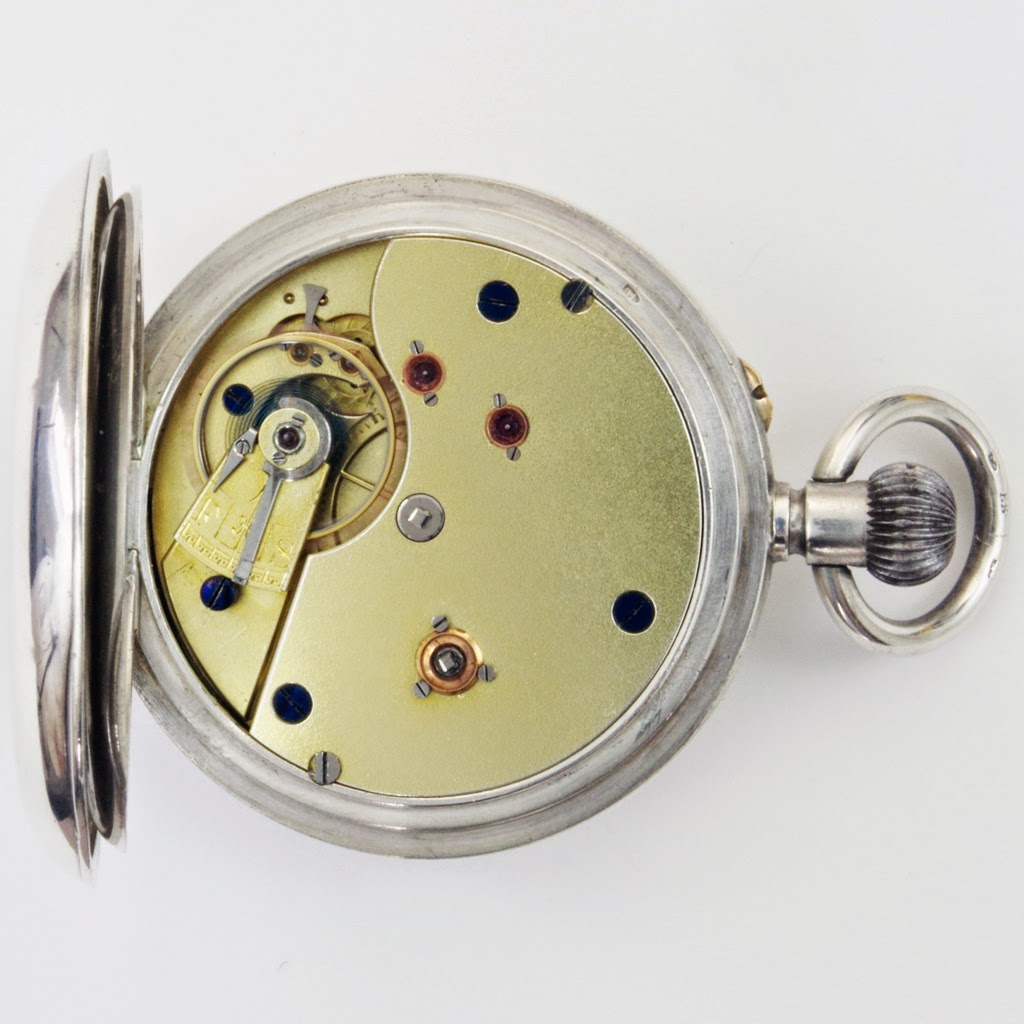
Imitation is the sincerest form of flattery: A Swiss 17J Half Hunter c 1897.


But in the case of this Swiss watch the unknown maker should have been more confident and signed the watch. It  is the best made and finished Swiss watch I have come across, better I think than the Labrador by Louis Brandt and Frère / Omega  and at least as good as the early Rotherham it rather looks like. (Sorry Coventry Watch Museum  J also on Facebook ).

The movement was clearly made for the English market having the classic Rotherham shape, Fast and Slow markings without the French equivalent (A & R) and a true English Lever Escapement. It has 17 jewels, 15 plus cap jewels on the escape, and they are all screw set on the top  and three are on the face plate.
The Breguet sprung cut compensating balance has, apart from the timing screws which are steel to  gives finer control of the timing, gold screws which is not common in a Swiss watch. It also has a double roller and a functioning Geneva gear to control mainspring pressure.
The setting gear is particularly impressive with every piece very well finished.
 

Friday, 13 March 2015

An early and rare Waltham Traveler


About 286,000 1899-Travelers were made as well as almost 400,000 of the 1908 model, this watch was in the first 10,000 made (5th run) and in the first batch of the 11 jewelled version of which only 4,500 were made in total (Hunter and Open Faced).

It has a split plate movement with 11 jewels, screw set apart from the lever. The Swiss lever escapement has a cut compensated balance with Breguet Spring. The serial number dates it to 1899.

The half hunter "Empress" grade case is in Filled Gold and is by the Canadian factory of the American Watch Case Company - locating manufacturing operations overseas to save tax is not a new phenomenon!

Sunday, 8 March 2015

An early Louis Brandt and Frère Labrador

LB&F Labrador c1895
As described in another post Louis Brandt and Frère had two main movements after c 1894, the Omega and the Labrador.

Here we have an early 3/4 plate version of the Labrador with a picture of the more usual split plate version for comparison.

LB&F Labrador c 1896

Saturday, 7 March 2015

A 19J Rotherham from 1902/3 signed and presented by the company.

I continue to get in some very good watches by Rotherham and in the last six months have had more than in each of the previous 2 years. 

This one is particularly interesting as it was not only signed "Rotherhams, Coventry & London" it has engraved on the dust cover:

"Rotherhams' Swimming Club, Coventry, 120 yds. Open Handicap Sep. 19. 1904. 1st Prize. Won by F. Burre".

Monday, 2 March 2015

A rare "Own label" Waltham 1908-641 model:

Very few UK resellers, I can only recall two or three, commissioned special "own label" movements from Waltham, this grade 641 from 1918/19 looks to be a P.S. Bartlett with the addition of a double roller. The total production run of this grade was 150 open faced movements and 350 hunter movements.

It is signed "Preston Senior, Especially made for Prestons Ltd, Bolton, By Waltham Watch Co, Waltham U.S.A.".

I have also seen 1908-635's branded for Thos Russell of Liverpool and a lower grade, probably a 15J branded the "Preston Junior". A couple of others I know are now with a collector in Australia.

Wednesday, 11 February 2015

Does non-functional Geneva gear matter?

This post was prompted by my restoration of three watches by Rotherham of Coventry (an unusual number to have in at one time!) two of which had fully functional Geneva stop gear whilst the other was missing part of the device.

As explained in some detail in this previous post Geneva Stop gear is designed to limit the maximum and minimum pressure from the mainspring to help control isochronism (varying time keeping as the watch runs down).  But quite frequently the "nib" on the central portion is broken or the other section is missing altogether. This is, I suspect, normally down to previous repairers letting down the mainspring too fast which is easily done. It may also have just worn out, broken as a result of some other fault or been removed to give the watch a longer run time.

A modern
Mainspring
So does it matter that it is broken? Well the answer, as is frequently the case, is yes and no.

Yes it matters because the watch is not complete, so I always discount them a little. And yes if a contemporary mainspring was used it would most probably have a noticeable impact on time keeping.

But thing have changed in the way that mainsprings are manufactured; in the 1800's and into the twentieth century mainsprings were made equally thick through out their length so that as they unwound the pressure from the still wound coils delivered unequal pressure over the period.

A modern mainspring on the other hand  is made so that the strength varies along its length to reduce variation in pressure. This significantly mitigates the problem so that on a 120 year old watch the affect on timekeeping is unlikely to be significant or noticeable without close monitoring.