

Saturday, 9 August 2014
July Market Update & Four Bensons!
July was an odd month with watches in short supply, but, not for the first time, the trend was bucked by unconnected batches of some quality watches, in July it was watches by Rotherham, Omega and these four by Benson. Three open faced watches made by Tavannes and a rare Half Hunter made by Recta. The later sold in about half an hour and could probably have been sold half a dozen times.

Thursday, 7 August 2014
Hunter, Half-Hunter or Open Faced?
The choice between the three types of watch is one that should be made for aesthetic reasons, not because of any perception that the Hunter type is more robust, in fact in some ways it is not. This post explores why and gives some of the pro's and con's of the different types.
First what are they?
The Hunter is so named because with a lid covering the glass it was more suitable to wear when riding a horse (to hounds - hence it is known as a "Hunter") than an open faced watch as there was always the chance of being thrown against the pommel of the saddle and crushing the watch. This was a significant issue when, before about the mid 19th century, watches had a hugely domed "bulls eye" glass front, it became less of an issue however when the glass became significantly flatter and was less susceptible to damage. A secondary advantage was that the front cover protected the glass from being scratched although the front window of a half hunter was at least as susceptible.
Advantages:
The Half Hunter is in my view preferable to the Hunter:
Advantages:
First what are they?
- The Hunter has a solid one piece cover or lid over the "crystal" and watch dial, normally by pressing the crown the cover should pop open by itself - if you don't get your thumb in the way of the hinge!
- The Half Hunter (a.k.a. Demi Hunter, very occasionally a "Napoleon" and referred to by the Lancashire Watch Company and presumably by others as a "Sight Hunter") also has the cover but there is a small window in it so that the time can be read reasonably well without opening the lid, the hour hand should be distinguishable from the minute hand when looking at it through the window, this is usually achieved by having two large swells on it - see the picture below.
- The Open Faced watch just has the "crystal" which normally was glass. Later various types of plastic was used, which often changed a nasty yellow or green colour over time. A modern replacement will usually be acrylic and looks much like a glass one, it is essentially unbreakable and makes an open faced watch perfectly strong enough for normal use. Acrylic is more susceptible to scratching but a replacement costs only a few pounds (plus fitting).
 |
| A Waltham "Hunter" |
Advantages:
- They can look good and there is a certain ceremony, which many people enjoy, of taking out the watch and popping it open to tell the time.
- The crystal is protected from scratching.
- You have to open it to tell the time and if worn in the breast pocket of a jacket (how I normally wear mine when wearing a Tweed jacket without a waistcoat) that is not easy.
- They are rarer, particularly silver ones, and to many are more desirable and so are more expensive than an open faced watch.
- The hinge for the front lid is vulnerable to wear and to accidently being bent or in severe cases torn off.
- The springs that open them can break and replacing them, particularly on English watches, can be problematical, however replacements for "standard" watch cases, particularly those by Dennison can usually be found.
 |
| An English Half Hunter by J.W. Benson |
Advantages:
- The time can be read without opening them which is more convenient.
- They look very good.
- As for the Hunter except as mentioned above.
- They are much sought after and so are more expensive again than the Hunter.
Tuesday, 29 July 2014
Newsome dial replacement.
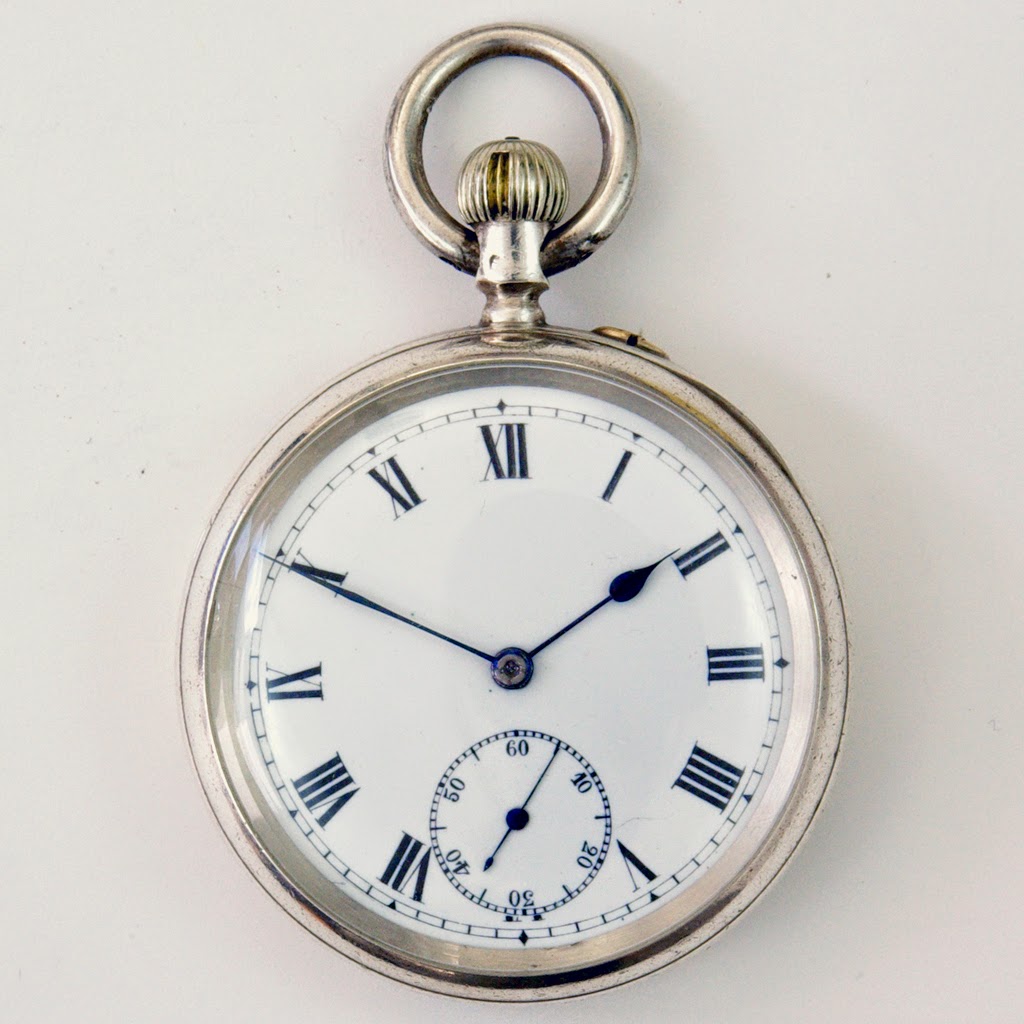
This posting shows how it should be done, and that is not by clipping off the fixing pins and using Blue-Tac or glue to fix the dial to the movement, a technique I see used fairly frequently on watches I buy in.

The first thing is to find a dial from the right period that is of the right size with the hole for the second hand in the right place. You then need some replacement dial feet.

Normally these can now be glued or soldered to the face but on this movement the dial is retained with pins rather than clamped in with screws, so the feet first have to be drilled with a 0.5mm drill held in a pin chuck. A fiddly job as the pins are round.

The pins are then positioned in the movement with "springy" dial washers or similar underneath to get the flat end of the pin high enough to contact the dial, the newly drilled securing holes have to be lined up so that the brass pins can be inserted when the movement is finally assembled.

A thick glue such as the resign based Araldite or Loctite Hysol is then put on the feet plates and the face carefully positioned so that the centre hole is in the centre and the seconds hand hole is correctly aligned.
And there we have it, a hundred and two year old watch has a new lease of life.
Sunday, 6 July 2014
June market update
 |
| LWC half Hunter, 1910 |
It was much the same with Swiss watches with 7 signed by J.W. Benson of which 6 were by Tavannes and another Tavannes for Russells Ltd. So from 22 watches completed in the last 5 weeks or so 13 were either by Tavannes or the LWC, of course Benson is a brand I specialise in and so buy more aggressively but even so the proportions are odd.
 |
| P & A Guye, 13J, London 1892 |
The month closed out with a couple of nice English watches not by the LWC and I have some more coming in that hopefully will appear on the web site in a week or so.
Saturday, 5 July 2014
A rare Beesley Silver Hunter, 1883, with an interesting engraving and repair.
 |
| A 17 Jewel Pinset Hunter by Beesely for J.W. Carter. English Silver, 1883. |
There are a couple of interesting features, an old repair and the case engraving with love symbolism.
Saturday, 28 June 2014
J.W. Benson War Service Presentation watch
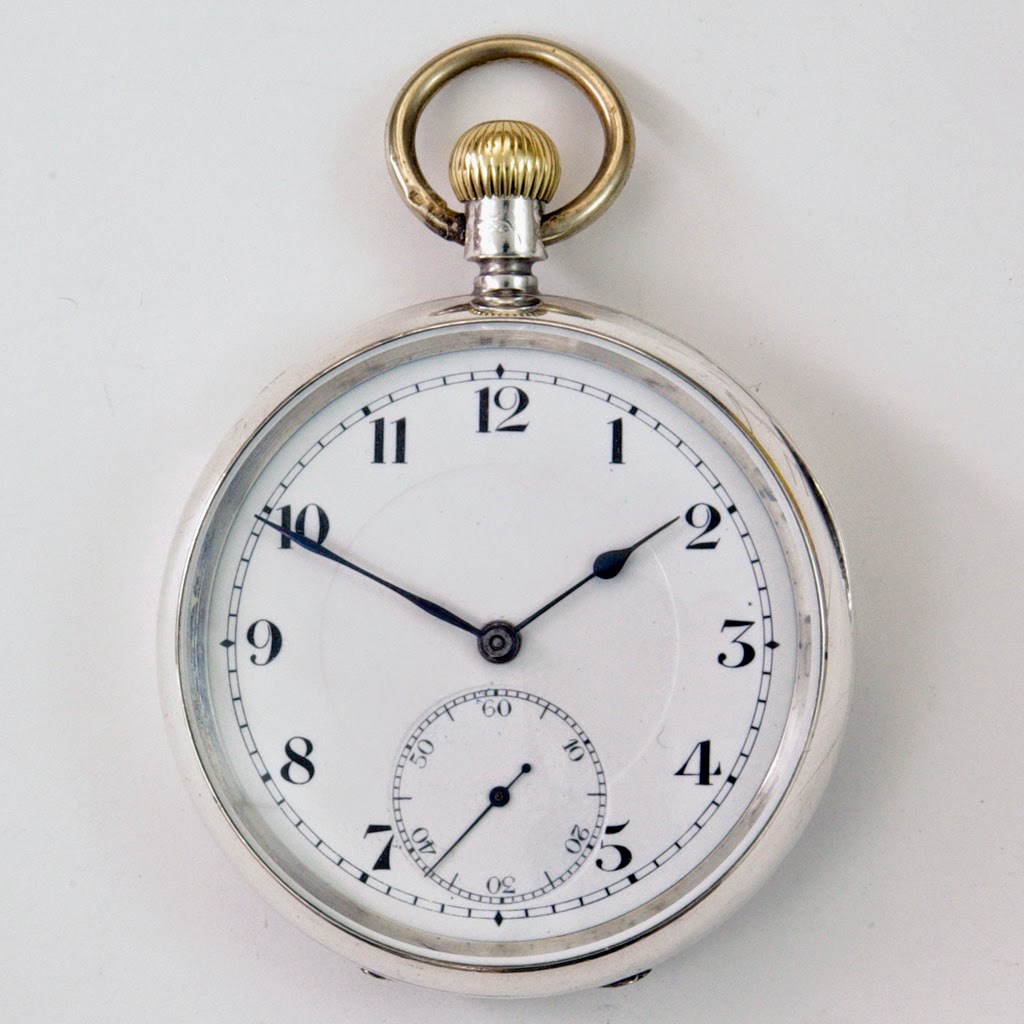
An appropriate post for the anniversary of the shooting of Archduke Franz Ferdinand in Sarajevo on 28th June 1914.
The watch has a 15 jewel movement by Revue Thommen for J.W. Benson. It is interesting to note that in 1918 they are still engraving movements "J.W. Benson, 62 & 64 Ludgate Hill, London, By Warrant to H.M.
the late Queen Victoria" 17 years after her death.

Of more interest is the engraving on the dust cover:
War Service
1914-1918
Bombr G.H. Martin.
R.F.A
Presented by
The Parish if Erbistock
Monday, 23 June 2014
The Waltham 1899-174 & other 11 jewel watches that try to look more than they are.
 |
| Waltham 1899-174, 11J 1902 |
But the interesting thing is how the jewels are laid out. After the basic seven jewels the most efficient layout is for them to be in pairs top and bottom of each staff and put where they will do most to reduce friction and the impact of that friction on the watch. That will be the staffs moving fastest which happily in a watch are also the ones with the most gearing effect.
So with four additional jewels these would normally be set in pairs on the lever pallet and escape wheel or, as favoured by a number of quality English makers, on the escape and seconds wheel. But on this movement the extra jewels are lined up on the top plate, why?
 |
| Cyma 10J for Thos Russell |
This is so that the buyer (or perhaps a seller?) can show off the watch and claim it has 15 jewels!
Others went further, the second movement shown has ten jewels in the presumed hope that no one will notice that the top pivot of the lever pallet, small and hidden under the balance, is not jewelled.