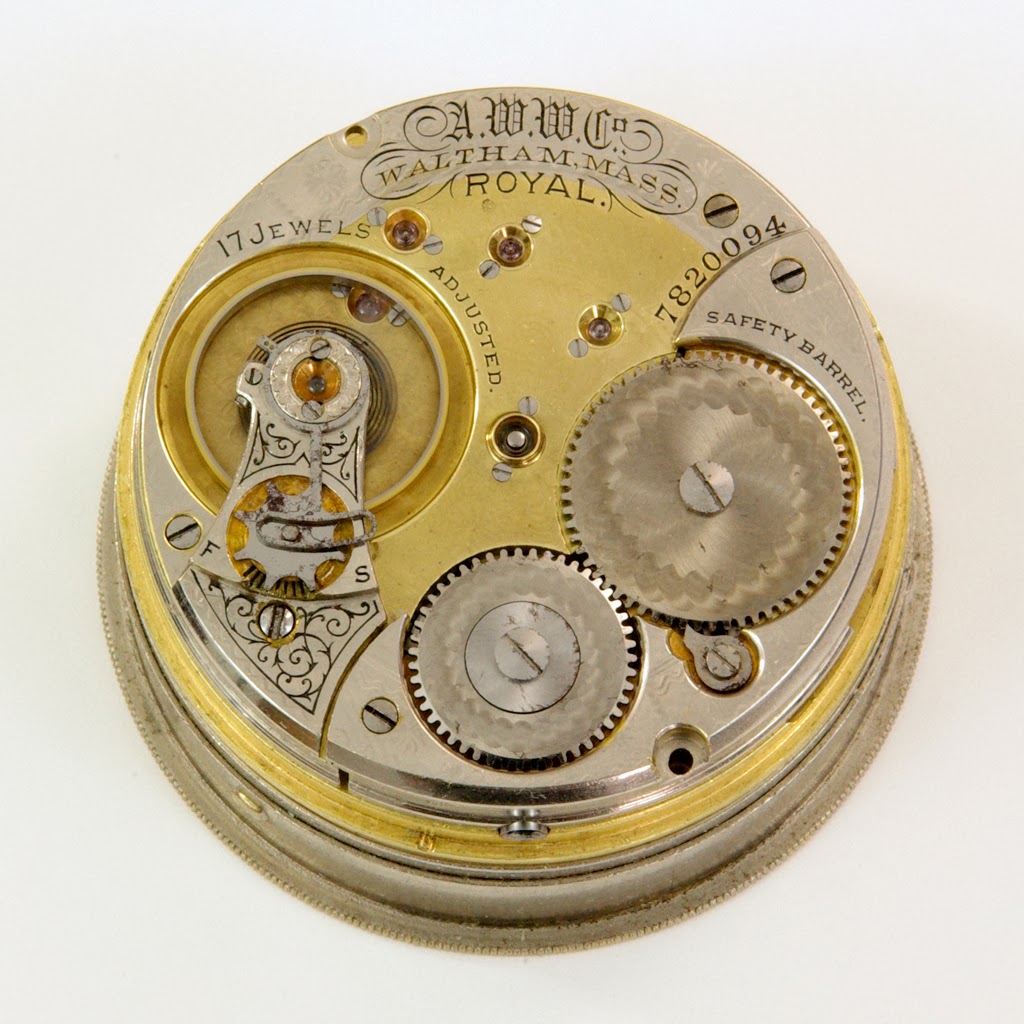
Probably as much that is known about the production history of this grade and model is on this specialist site so I will not repeat it here.
Thursday, 27 February 2014
Two Tone Waltham 1892 Royal
A rare and very attractive size 18 1892-Royal Two Tone from 1896/7 just finished restoration. It is pendant set and the Swiss Lever movement has 17 Jewels and a Breguet sprung cut compensating balance with single roller.
Probably as much that is known about the production history of this grade and model is on this specialist site so I will not repeat it here.
Web Site
I understand that some customers cannot access the web site, neither was I this morning but I thought it was fixed by lunch time. I am chasing the service provider to find out what is going on and hopefully they will sort things out!
Wednesday, 26 February 2014
February Market and Stock Update
In the three months to the end of January I sold 90 watches which is far in excess of the rate I can restore them as a “one man band”. During February the number sold dropped significantly, probably as a result of very low inventory, seasonal factors and a bias in my inventory towards more expensive American railroad watches over the last couple of months. But still inventory only increased slightly.
Good quality English watches continue to be in very short supply, I have not had a restorable English Benson or a Rotherham in since November and the next level down is almost as bad. I have therefore been buying a lot of railroad and other high grade Waltham watches from America and probably now have the best selection of these watches available in UK if not in Europe. More are on the way but anecdotal evidence suggests that the US market is also tightening which suggests a worldwide shortage of good quality pocket watches and a general increase in prices of watches for restoration, as I have seen here in the last 4 – 6 months.
With the Salmon and Trout fishing season starting shortly in this part of the world I will “only” be working 4 or 5 days a week (this is meant to be a “retirement” business!), so the current level of demand would be about right for me but enquiries are starting to increase again with the approaching spring wedding season so I anticipate that availability will not improve significantly in the medium term.
The Waltham Equity
This is one of a series of posts
illustrating the main grades of Waltham size 16 watches, primarily the 1899
& 1908 models. Note that specifications did change over time, the
description below being typical.
The Equity was originally sold as
being made by the Equity Watch Company of Boston and was not associated with
Waltham, later after it became generally known that it was by Waltham it was
bought in from the cold as a Waltham model.
It is essentially a Waltham 1908-Traveler
with the variant plate design but in nickel. The movement has 7 Jewels, a Swiss
lever escapement with a Breguet sprung cut compensating balance. It is
unadjusted and has a single roller. About 54,500 were made in total.
The example shown is from 1918 and is signed by Waltham.
Tuesday, 25 February 2014
Double Watch Frustration.
This movement was
covered in a recently applied film of an oil far too heavy for use anywhere
near a watch causing components to stick together and to my tools. The hairspring was drenched with most of the coils stuck
together and could not possibly work.
The cleaning process took about three times as long as usual even
with the help of an ultrasonic cleaner and some serious de-greasing agents.
Fortunately it was successful and the movement is now running exceptionally well
after getting a new mainspring and a lot of TLC.
The second frustration is that I do
not know who made it, a recurring problem with watches from the fragmented English
industry. This 13J English Lever was made in Coventry in 1893 from a Prescott ebauché - a kit
of the main parts of the watch. So all I can say is that if the serial number
represents the number actually made it is by one of the smaller Coventry makers.
Monday, 24 February 2014
Waltham 1888-Riverside
The 1888 was the forerunner of the 1899 model and is very similar, apart from the shape of the plates and balance cock there are two main differences, firstly the winding and setting mechanism is wholly contained within the movement with a captive winding stem rather than having the stem captive to the case with the in/out position set there as was the case with the 1899 model which used the newly introduced "standard" case.
The Waltham production records show about 37,000 15 jewel and 20,000 17 jewel versions of the Riverside, of the 17J versions about half were hunters and the rest open faces or undefined. In addition one 19 jewel version and thirty seven 16 jewel versions are recorded.
Shown is a recently restored example made in 1894, it has an adjusted17 jewel movement, the Swiss lever escapement has a Breguet sprung cut compensating balance with micro adjuster and double roller.
Sunday, 23 February 2014
An "In Beat" Design by W. Ehrhardt.
| W. Ehrhardt Full Plate Keyless. 1920 |
This design makes the watch rather more robust, slightly slimmer (although it is still considerably thicker than a three quarter plate) and makes it very easy to get the watch "in beat".
Being in beat means that the balance action is symmetrical swinging an equal distance in each direction and that the balance staff, impulse jewel and pallet arbour are in perfect alignment. If you think in terms of a long case clock the "tick" equals the "tock" and it has a steady rhythm.
This can normally be a tricky operation involving quite a lot of work and often much fiddling with the hairspring which always has some risk attached to it. With this design the impulse jewel can be lined up simply by rotating the balance cock to the correct position and locked there with the two screws that hold it to the movement.
Unfortunately it did little for Ehrhardt who was out of business shortly after, or for watch design as the full plate movement was already obsolete by the time this was made, replaced by the three-quarter and split plate movements.