Showing posts with label Watch Cases. Show all posts

Sunday, 31 March 2019

Carnegie Hero Fund watch - untangling the hallmarks.


The inscription says
"HE SERVES GOD  BEST WHO MOST NOBLY SERVES HUMANITY"
(I am told!)

The Errington movement has an English Lever escapement and a
Bregue sprung cut compensating balance.
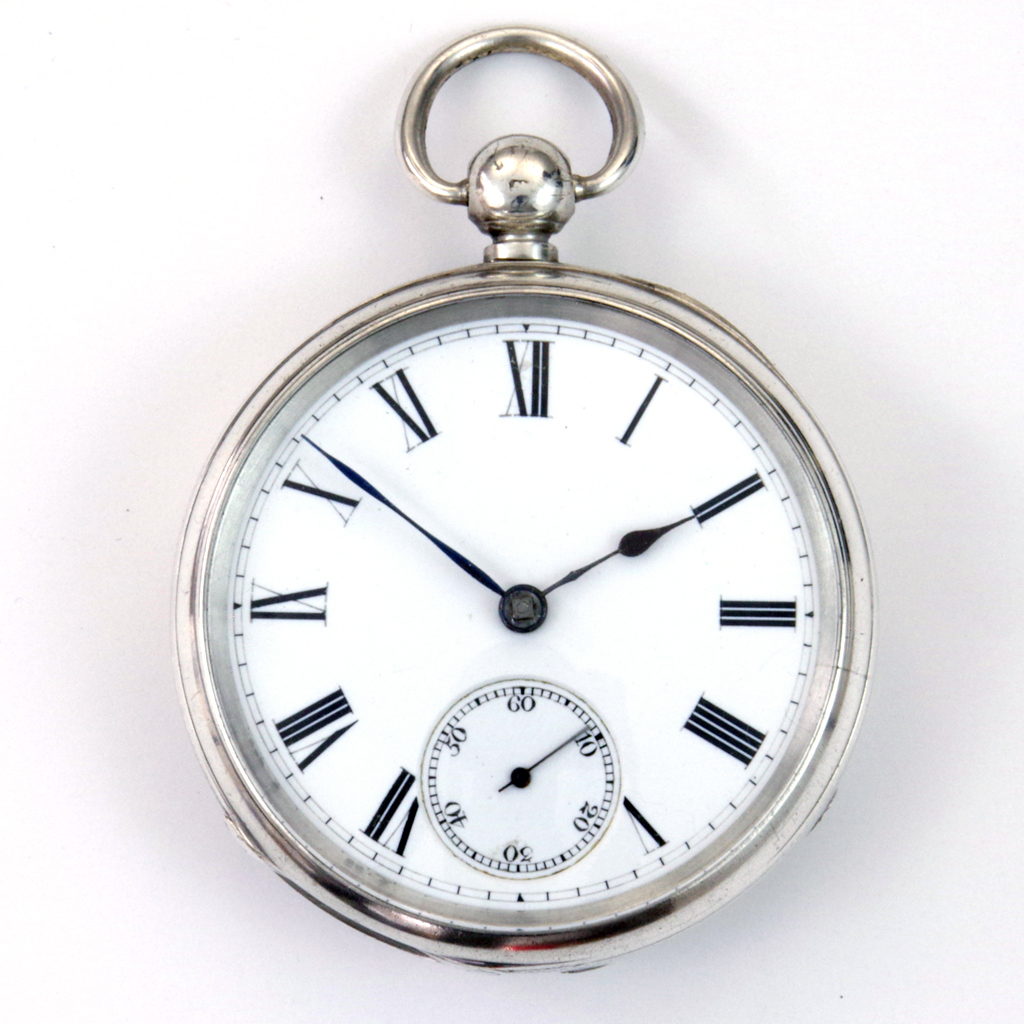
The watch is from the Errington Watch Factory in Coventry (then owned by Williamson) for David Harley of Dunfermline but the case was much modified before being presented to William Russell by The Carnegie Hero Fund for saving life in 1912.


The hallmarks are interesting:
  • There is no Assay House mark.
  • The dust cover has the makers mark "C & W" and London date marks for 1910 /11.
  • The front cover has the makers mark "ATO" and London date marks for 1911/12.
  • The pendant marks are difficult to read but look to be "CH" , Birmingham 1911/12 and
  • The highly decorated back lid has no marks at all.
The case was originally made by Thomas Clark and Alfred Ward of Kensington Rd Coventry ("C&W"), who I know from other examples were making cases for Errington watches at this time, the Errington ("C.H.E") mark having been cancelled in 1905. So the Dust cover is almost certainly original to the body.

As was common the pendant was made by a specialist pendant maker, in this case by Charles Harrold & Co.

The back is more complicated. It is not in one orriginal piece the centre having been cut out and a cast silver disk with the Latin moto and a hero's laurel wreath expertly let into it. This removed the hallmarks, including the London Assay mark, but as the back was now modified and from two makers it could not be resubmitted for assay and could not have had 2 sets of marks. It is OK for two lids to have different marks because they are hinged to the body and are considered different pieces of silver - which is why they are individually marked in the first place.

The history of the front lid is more problematic, the "ATO" mark is that of Albert Oliver of Clerkenwell, London. I can think of two reasons it is different to the rest, either the original was damaged during the engraving and had to be replaced or, my guess, the watch was original a half hunter and was converted to a hunter so that the long engraving could be put in a visible place.


Friday, 26 August 2016

What size to buy?


Moved from the web site and updated.

Jump the next 3 paragraphs if you are a technophobe or just bored with the detail :)

The detail: 

 
Watch Sizes are specified by the diameter of the movement where it fits in the case, there are now two common measures, “Lancashire” for English and American watches and “Ligne” for Swiss.
An unrestored S12 fusee movement
with its carrier and oversized dial.
Lancashire starts at size 0 which is 1 5/30inch increasing by 1/30 inch per size. So the popular men’s size 16 is 1.7 inch and size 18 1.77inch but it is quite possible for a watch case to make a smaller movement look several sizes bigger although the dial remains the same size.
It was also common practice to mount 19th century English movements onto the back of a carrier two sizes bigger, the carrier attached to the larger size case and had the larger size dial on the other side so that it was indistinguishable from the larger size watch without opening it up.
Where quoted I normally use the nearest equivalent “Lancashire” size for Swiss watches.
As a rough guide the following table shows the approximate diameter of the watch for "normally" cased American and Swiss movements, some may be rather larger but a few can be smaller.
  • S14 4.9 – 5.0 cm
  • S16 5.0 – 5.2 cm
  • S18 5.4 cm+
English pin set watches will typically be a little larger as will full plate watches (because they are thicker).

Movements of size 12 and below and size 18 and above can vary significantly in size when cased up, so on the web site I normally give the dimensions for each watch as part of the description.
Here are some general guidelines on what each size of watch is best suited for, clearly there is room for variation here particularly for ladies if they are wearing a waistcoat or carry the watch in a handbag. And although a Fob watch is normally defined as one below about size 8 it is really only limited by the size of the fob pocket! 


A Ladies size 6 Waltham, heavily patterned cases are
frequently used on these smaller watches.

Size 0


Ladies watches only, suitable for wearing on a neck chain as a pendant (but be careful not to swing it around too much and bash it on something) or as a brooch with a suitable attachment.

Size 6


Ladies, as size 0 or as a fob watch. Men, as a fob watch.


A size 12 Rotherham although tightly cased
for a pin set watch it is still 1.9" / 4.7cm
 in diameter, about the same an American size 14

Sizes 12


Getting rather large to be a Fob watch but some American size 12s will be OK used as above. Many old size 12 movements are put into size 14 cases with the use of a carrier as described above.

English pin set size 12s make a good sized mans watch.


Size 14 & 16


A size 16 hunter in a New Old Stock Dennison
case. A Hunter will always be a little bigger
than an open faced watch due to the space
 taken by the bezel and lid.
A common size in the nineteenth century in all forms, this became the “standard” man’s size for keyless watches in the twentieth century, these are generally quite slim so do not distort pockets as much as earlier key set watches.

This was the smallest size that could be certified as a “Railway” watch in the USA (beware of this term! Originally it defined an accurate and reliable timepiece suitable for controlling railroad traffic in the US, later it was picked up as a marketing ploy and appears on some really awful Swiss watches – you have been warned!).


A tightly cased Waltham 1892 railroad watch.

Size 18


Originally the watch to go for to show status and now very popular with collectors, particular of North American watches and it is frequently said the bigger the better. Some very fine watches were made in the calibre.

Size 20 & 22


As for Size 18 but really showing off, not that common and most in UK are key set from the front and made in the 1890’s and very early in the new century.

Size 24+


Are really too big to carry around but frequently would have had a special stand to convert them into something you could use as a travelling clock.

Thursday, 25 August 2016

Can I engrave a watch?

Moved from the web site.

With solid Gold, Silver, Nickel and alloy cases such as Silveriod then the answer is yes but be aware that dedications will generally decrease the value of a watch.

The example here may be one of the exceptions, it reads “Presented to my stepson, F. Cavalier, March 23rd 1899 in recognition of his dutiful perseverance and honourable conduct in my business. W Cockerton”.

Gilt or electro plated surfaces cannot sensibly be engraved.

Engraving Gunmetal is probably not a god idea.

Gold plated watches can be a problem: A Dennison rolled gold (Star Grade) case started life with about 0.036mm of gold on the outer skin and were electro plated on the inside, so after years of wear and polishing the outer skin is probably going to be too thin to take an engraving without going through to the composite core, and an engraving on the inner skin would definitely go thought to the core.

A Dennison Filled gold case started off at 0.072mm of 10 carat (Moon grade) or 14 carat (Sun grade) gold on both sides of the composite. Clearly having double the thickness to begin with means that these cases are more amenable to engraving but remember that 14 carat gold will wear quicker than 10 carat so a Moon case will be the best bet – although still risky, particularly on the back.

I assume, but can’t find a definitive statement to support, that the dust cover was of similar thickness and without pocket wear should be able to take an engraving, this is also the place to do it to minimise the reduction in value caused.

I don’t have information about cases from other manufacturers but guess they would be much the same when from reputable manufacturers.

To sum up, my personal view is do not engrave a watch case! Think about a personalised box or an inscribed watch fob medal to be worn on the chain which could be engraved without endangering the watch.

Finally I am not able to get engraving done and any you have done is at your own risk!

Watch Case Materials and Hallmarks

Originally on my web site and moved here with other faqs.
 
English cases, in descending order of value will normally be:
·         Gold, 9 carat and up
·         14 carat “Filled Gold” (25 year)
·         Stirling Silver (0.925)
·         10 carat “Filled Gold” (20 year)
·         10 carat “Rolled Gold” (10 year)
·         Nickel or other base metal

Under British law only solid gold & silver can be described as “gold” and “silver” and each part must be hallmarked by an Assay Office. This rule is sometimes circumvented by using terms like “Yellow" or "White metal”.
 
All British hallmarks include a date letter so the case, if not the movement, can always be dated but be warned the date letters were different for each office! This web site gives some good detail. The marks shown on the case lid shown to the right (click on it for a larger view) has the following legal marks:

·     Anchor = Birmingham Assay Office
·     Lion = Sterling (0.925) Silver,
·    The shape of the cartouches together with the date letter font and case indicate the Birmingham year letter sequence, in this case 1925/26 through 1949/50.
·    The Date letter K for 1934/35
·     An optional special mark for the Silver Jubilee that year
·     A.L.D., The makers mark of the Dennison Watch Case Company (A.L. Dennison).

Watch Case makers marks can be very confusing (they change all the time) and difficult to track down, the best reference work is “Watch Makers of England, A History and Register of Gold and Silver Watch Case Makers of England: 1720-1920” by Philip Priestly, 1994.

Essentially all English Gold and Silver case will have been assayed in Birmingham, London or Chester. Imported cases can be submitted for assay and will have a different stamp than English silver, almost all came in through London.

Like watch movement making case making was a fragmented industry in England with hundreds of small independent operations, some for instance just making pendants or carrying out a limited number of operations which is why you frequently find a different hallmark on the pendant to the rest of the watch case.

A case by the Lancashire Watch Company but with the
hallmark of the retailer - J.G. Graves.
Some of the bigger watch makers had in-house case making operations, at least for some of their output, but you cannot necessarily tell from the hallmark as the real maker could submit the case for assay on behalf of his customer, so for instance the Lancashire Watch Co could and on occasion did have cases stamped with the Graves “makers” mark which in reality is a sponsors mark which is what it is officially called today.

Similarly many silver cases carry a Waltham hallmark (A.B for Albert Bedford), but Waltham did not make them but bought them in from their contracted supplier A.L. Dennison, one of Waltham’s founders who had left under a cloud and who subsequently set up the eponymous British company, probably with some financial help from Waltham and from Alfred Wigley who’s mark [AW] is on some Dennison made pieces.

Swiss Silver 
Hallmarked Swiss 0.935 Silver.
Watch cases were hallmarked in Switzerland (if not in London), in fact the only silver items that had to be, but they can only be dated as being from before 1882, after 1934 or between those dates. There is no makers mark and the purity standards are different to English, most watch cases are 0.800 or 0.935 although 0.875 is occasionally seen.

US Silver is a mess with no legal definitions until 1906 but most cases stamped “Coin Silver” were between 0.892 and 0.930 as used in US coinage which was frequently melted down for watch cases, as English currency was for English cases.

Rolled gold is usually a plate of gold c 0.036mm thick(Dennison cases) pressure welded to a brass composite core and with the inner surface electroplated. Filled gold has a plate on both sides of the core and it's usually thicker, about double. The warranty period was mainly a marketing ploy to distinguish good quality watch cases from cheap electroplated imports and it was never made clear who was standing behind the warranty! The gold is usually 9, 10 or 14 carat. More detail on filled and rolled gold are in this separate post.
American rolled gold cases are much the same.

Silveroid, Silverine 
A Keystone "Silveroid" case, many of this type are
marked "Guaranteed imitation silver".
and similarly named metals were alloys , frequently of Nickel, made to imitate silver at a fraction of the cost, very popular in America they were less common in Europe, at least under the trade names.

Probably a significant majority of good quality keyless Pocket Watches in this country from after the mid 1890s were originally in rolled or filled gold cases with most of the rest in Sterling Silver or gold. Many Rolled & Filled gold cases will have the plate worn away (often referred to as brassing) and so there will usually be more silver ones on this site and the respective values do not necessarily reflect the intrinsic value of the material.

The majority of good quality full plate, key set watches were in Silver.

Wednesday, 24 August 2016

Gold Plated Watch Cases

The gold plating of watch cases can be rather confusing, this post is an attempt to demystify what should be something quite straightforward, unfortunately there are, as ever, some wrinkles often caused by unscrupulous makers and resellers, normally at the lower end of the market and by the lack of legislation on the subject nationally and internationally at the time pocket watches and their cases were being made..

I will be looking at the manufacture of the fabric of the case, not the gilding of silver and other processes used for applying ornamentation of a case (or movement). So only two processes need to be considered, electro plating and pressure welding of solid gold to a brass or composite substrate or core.

Electro plating using a number of different processes was only used on the outside on very cheap cases as being very thin it goes not wear well, but is was used on the inside of cases in combination with pressure welded plating on the outside.

Pressure Welding.

One way of permanently bonding two metals is to put two or more plates together and then to put them through a rolling mill which as well as reducing the thickness and the great pressures involved will cause the surfaces to become welded together.

Filled & Rolled Gold.

Although, at the time, there was no legal definition of these terms - in UK a proposal was made but the legislation never materialised - it was generally accepted that Filled Gold was made by pressure welding a plate of solid gold to each side of a core which was normally a composite / alloy of brass.

Rolled Gold was a single plate of gold pressure welded to one side of  a core with the other side electro plated.

Case bows and links of watch chains were made by a similar process with gold wrapped around a central core and then pressure welded, this was classified as rolled gold, even if the watch case as a whole was "filled" gold.

The thickness of the gold plate was a determining factor in cost and durability. Higher quality gold, normally 14 carat, being softer would need to be thicker to give the same durability as a 9 or 10 carat plate.

Dennison Cases

The Dennison Watch Case Company, based in Birmingham, was second to none worldwide in the volume production of watch cases and fortunately some of the technical specifications of their cases are known:
  • The Rolled Gold "Star" grade had a 9 carat gold plate thickness of  0.036mm and were "warranted" to last 10 years.
  • The Filled Gold "Moon" grade in 10 carat gold had a plate thickness of 0.072mm and were warranted to last 20 years.
  • The Filled Gold "Sun" grade in 14 carat gold also had a plate thickness of 0.072mm so it is little odd that these cases had a 25 year warranty being softer than the 10 carat Moon and of the same thickness. But of course all three grades normally outlasted the warranty and if a Sun grade lasted only 20 years I doubt the owner would have been perusing the issue after all that time.


Silver marks - don't let the pendant maker fool you.

This post was inspired by an item incorrectly described on eBay where someone had got confused between the maker of the pendant and the case.

Pendant making was a trade in its own right and some case makers did not want or were unable to make their own so bought them in from specialists who might put there own mark on the pendant even if the finished item was to be submitted for assay by the case makers or a third party.

The example shown has the mark "C.H" on the pendant but  another example from the same case maker has the mark "WN".

Saturday, 13 August 2016

J.W. Benson movements in Dennison cases.


Large numbers of Benson cases were made by Benson Bros[i] (no relation) of Liverpool, but carried the J.W. Benson mark and for solid gold and silver the London assay marks.
A witness mark (just to the left of the case screw hole)
showing that the movement does not belong in this case.
Note the Dennison safety bow on the case.
Benson watches from the 1930s with “standard” sized movements by Tavannes are frequently seen on eBay in silver cases by Dennison, most of these are marriages probably using movements that originally had a solid gold case. These frequently have witness marks from other movements visible on the case as illustrated here (I don’t buy these watches except for spares so the example shown is the movement from the watch below placed in a case from a Waltham watch).
Some however do not bear witness marks but could still be marriages with cases originally from Tavannes watches.
A 1933 Tavannes movement for J.W. Benson in
a Dennison silver case hallmarked 1933
Whilst Benson could have used Dennison cases when short of their own, for quite a while I considered that the majority of these Dennison cased watches were marriages but then saw some with provenance covering 40 or 50 years and I began to wonder, whilst I am very sceptical[ii] about family history, a relatively recent history (when the owner was not trying to sell) probably precludes a watch having been recently re-cased.
Having done some research[iii] I found that the Benson Bros business, including the contract with J.W. Benson, was purchased by Dennison in the early 30s, case making was transferred to Handsworth whilst the original Benson Bros operation was turned over to repair work.

This makes more sense of watches from the 1930s occasionally having Dennison hallmarks. The date of the transfer is not known but was certainly complete by 1934. All of those that I have handled without witness marks showing re-casing, are hallmarked 1933 apart from one, the only datable Swiss Benson I have had from from 1934. So probably these watches came during the transfer of the business.
 
The back of the watch shown above.
The Dennison case shown here is confirmation of this as the date of the movement (from the serial number) matches that of the case. Also the case is not typically Dennison of the period as it lacks their normal patented “Safety bow”, as do all of the gold and silver cases in my mid 1930s J.W. Benson sales catalogue.
It is also possible that the case was originally made for Benson but was sent to Birmingham for assay due to a queue at London or it was made for another third party and diverted.


[i] Previously the business founded by of R. Samuel, Benson Bros from c1894 and from 1902 owned by J.B. Eastham.
[ii] Well justified I think having been told several totally implausible histories saying for example that a hallmarked watch from the 1920’s was 19th century and the hallmarks were wrong, a London assay having been stamped with Birmingham date marks, because “it has to be that as it was definitely Great Gt… Grandad's 21st Birthday present” - although not engraved as such .
[iii] Primarily from Priestley “Watch Case Makers of England”, NAWCC Spring 1994.

Wednesday, 2 March 2016

An Old Elgin and a Very early Dennison case.

11J Model 1 Elgin 1873
I originally thought this watch was English but John Scott in Australia, my eagle eyed guru on American watches, suggested it was in fact an American Elgin - a make I rarely see, especial in this size and from this date both of which would be very rare in the UK.

Checking the Elgin production records showed that he was correct and that it is a fairly early size 18, model 1 grade 18, class 5 movement from c1873 and reputedly one of the best models they made. It has 11 jewels and a Swiss Lever escapement laid out tangentially as an English Lever and with an over-sprung cut compensating balance.

It winds clockwise from the back and is set from the front by using the key on the "hub" holding the hands.

The really interesting part however is the English double backed, triple hinged, silver case which is a rare and very early case by Dennison who came to dominate the English volume case making industry and was second to none in the field world wide.

Priestley's "bible" (i) on English watch cases reports that Dennison family records show the business started in late 1874 but it also shows that the ALD makers mark was entered on the register (presumably, not for the first time) on the 20th April 1876. The back lid of the case has the date letter used in 1875 and again in 1900 with the shield cartouche indicating 1875, the Birmingham Assay house mark with it is also in the shield for the 1875 date series.

However the lion silver mark on the back lid and the date and silver marks on the dust cover (the assay house mark is not required to be repeated but usually is) have the cartouche for the 1849 series used up to 1874/5.

So the case was certainly made within in the first 12-18 months of Dennisons move into case making and well before he joined with Alfred Wigley in 1879 after which the business took off.

But there is a very strong probability that it was made as the hallmark date sequence changed in early 1875 making this a case from the first few months of production.

It is even probable that the case was personally made by Dennison. This quote is from Priestley (i) showing what humble beginnings the company had, particularly when you consider that Dennison has previously been one of the founders of Waltham.
"Aaron started case making by using a pole lathe in the attic of his house at 27 Villa Rd, Handsworth, Birmingham".

Ref i: "A History and Register of Gold & Silver Watch Case Makers of England: 1720 - 1920" NAWCC 1994.


Friday, 22 January 2016

Restoring a Silver Watch Case

Click on the images to see a larger
version.
A while ago I posted a description of how a watch movement is cleaned, in this post I explain how I restore a silver watch case. The case in question was made by John Woodman of Smith St, Northampton Square, London in 1888.

From the wear pattern you may be able to see that the back of the case is depressed, there is also a dink bottom left and there is a lot of pocket wear, in reality it actually looks worse than in the picture. So something had to be done.


The first stage is to get rid of the worst of the muck and oxidisation, this is done with silver polish and a glass fibre brush.

If this were not done the next stage would not work as effectively and the fluid would have to be changed more frequently, perhaps after each case.


The ultrasonic cleaning is primarily to get into the parts other processes cannot reach including into digs and scratches. The fluid bath is detergent based and the case will stay in for 30 minutes which seems about optimal for a silver case.

The second ultrasonic machine shown is loaded with a solvent based cleaner that I use for cleaning movements.


The next stage is to press, rub or hammer out the back and the dents. This process will be different depending on the way the case is made and any finish such as engine turning on the back. Swiss cases in particular are sometimes made with a bezel similar to that on the front with a silver disk inserted - if you press on that to hard it will come out and be a devil to get back in and it you hammered the edge probably impossible.

It is better to press or rub rather than hammer as it will cause less damage to the inside which is difficult to burnish out due to the shape of the case and the necessity of preserving the hallmarks. The amount of work done on the outside has therefore to be balanced with the amount of damage to the inside and possible distortion of the case which may or may not be readily correctable.

The picture above shows the case after this work, the dink still visible but it is now more of a scratch or dirty mark.

For a case with a smooth back now comes burnishing with increasingly finer abrasives. A balance has to be struck between the amount of silver removed compared to the gain achieved in appearance and possible loss of structural strength.

In general I do not try and take out all of the marks but to still give a nice finish. All of this is done by hand.


Sunday, 6 December 2015

Waltham Display Case

Click on the image for a larger view
As described in some detail in my post "the standard watch case" buyers could at some retail outlets configure their own watch by selecting a case, movement, dial etc. and then to have the watch assembled for them on the premises

The Waltham display cases as shown here could be used to display a selection of movements to help the customer decide. I suspect the hole in the base was used to bolt it down to stop people making off with a potentially valuable movement.

Now this type of case can be used to simply display the movement or to use it as a desk watch.

Click on the image for a larger view
The back of the case has a second crystal so that the movement, in this case a 17 jewel Waltham 1908 P.S. Bartlett from 1918, is visible.

Friday, 7 August 2015

Dating Pocket Watches.

Revised and extended December 2016 from the original post August 2015

Dating watches can be a problem but here are a few ways that it is done.

American Watches

A Waltham 1892-Vanguard dated
to 1902 by the serial number, but
probably re-cased (see below).

These are generally the easiest as for many makes, such as Waltham and Hamilton, production records are still extant and enthusiasts in the US have put a huge amount of effort into putting them into online databases so by taking the serial number of the movement (not the case number!) and entering it you can get the production date usually to within a year or possibly two but sometimes to within a month.

Details of the type of watch may also be provided although there are some errors largely due to mixed production runs (e.g. lever and pendant set, etc..) and the occasional transcription error. The original Waltham database is maintained by the NAWCC but the most comprehensive site I have found is The Pocket Watch database.

Swiss Watches

Are more problematic, of the makes I regularly deal with, Omega have published the dates that each million watches were produced so by interpellation the production date can be determined within a year or two. Dates are known for Zenith and some for Longines, & Baume.

A Cyma movement with the serial
number under the dial
For most of the other makes the data is not generally available or, as is the case with Revue Thomman, the movements do not carry a meaningful serial number, just a 2 or 3 digit number to identify watches within a batch of production.

Having had a lot of watches by Cyma and Tavannes I have been able to build up a good database of serial numbers vs date for production between c1930 and 1938 using the silver hallmarks (see below) which is now good enough to identify the date to within a year. See this post for details.

Beyond this is comes down to experience and identifying key features such as machine set jewels which determines the earliest possible date.

English Watches.

An LWC movement showing the
serial number under the dial
dated to 1897.

Are very difficult, as far as I know production records are only available for the Lancashire Watch Company and those that are not accessible.

Other makes (assuming you can identify the maker!) are difficult as several companies appear to have multiple number sequences, indeed occasionally an Errington will turn up with two serial numbers one from each major sequence.

Generally it is therefore necessary to reply on silver case hallmarks or when in a filled or rolled gold case to compare with previous dated examples which may not be as reliable.

Silver Cases.

Silver hallmarks for 1903 by the
Birmingham Assay. The movement
is a Waltham 1899-620 also 1903.

English silver and gold case hallmarks are unique in having a date year, although until 1974 this is not quite in line with the calendar year and varied by Assay house with the Birmingham "year" starting in July and the London "year" in May, normally I refer to just the starting year, so Birmingham 1908 would indicate that the case was assayed between July 1908 and June 1909.

Some Swiss watches have only the Swiss hallmarks but others have English import marks.

For older English watches this is generally a reliable method of dating but with the introduction of the standard watch case we start to have problems due to recent re-casing of orphaned movements into orphaned cases, a problem which appears to be getting worse judging from what I see on eBay.

A subsequent post here will look at  how to identify re-cased watches. See also J.W. Benson movements in Dennison cases.


Wednesday, 3 December 2014

An interesting watch case


This high end size 16 Waltham has an interesting watch case by the Philadelphia Watch Case Co.

The main body is either filled or rolled gold, the bezel and back are in American "Sterling" silver with the back inlayed with yellow, green and rose gold.

Click on the image for a larger view.

Tuesday, 13 May 2014

The Standard Watch Case

Traditionally watch cases were made specifically for an individual watch and although there was some standardisation in diameter (The Lancashire size later taken up my the Americans and Swiss sizes in Ligne) the winding and setting mechanisms were not standardised and nor were features such as locating pins.

With the American drive to standardisation the "standard" watch case started to became ubiquitous during the 1890's with either a captive winding stem or a standard location for the pendant to support the winding stem.

This was a great help to volume case makers and supported the growth in plated cases as when worn out or damaged they could be replace off the shelf rather than having a specialist make or repair the old one at considerable expense.

It also led to a revolution in how watches could be sold at the wholesale and retail level. Watch movements could be exported and cased locally, often saving import duties, and more importantly watches could be cased at the point of sale.

So for instance an English retail jeweller in 1910 could buy in a range of watch movements from several makers, perhaps a selection by Waltham in different grades, some from Williamson or The Lancashire Watch Company and perhaps a few from Switzerland -where they had been forced to conform to the "Lanchashire" sizing.

They could then buy in a range of cases in Nickel, various grades of Gold Plate, Silver and solid Gold. And immediately you can "pick and mix" your watch, perhaps with a range of dials for the Waltham watches and the style of hands you wanted on any of them.

The watch could be assembled by someone using a few very basic tools and with minimal training, in some cases this would be done "on-demand" at other times to pre-set configurations as stock moved.

A tiny number of these new and unused cases remain and this orphaned movement by Tavannes for  J.W. Benson has now found a home in one such New Old Stock (NOS) rolled gold "STAR" grade case by Dennison.

Tuesday, 11 March 2014

A Fake "Saleman's" watch case.

Occasionally in the USA you find watches advertised as being in a "Salesman's" or "Display" watch case that has has a transparent back so that you can see the movement working.

I am a little suspicious that these were not actually for salesmen but I should have been more suspicious of the American watch with such a case I bought in UK where these cases are very rare and never seen on English watches - at least I don't recall seeing one - not least because English watch case construction does not generally lend itself to the form.

Here are the front and back of the case in question side by side.


If you look at the enlarged version of the picture, by clicking on the image,  you can see more clearly see that the front bezel on the right has a very worn pattern on it whereas the one on the left does not. What has almost certainly happened is that someone had a watch with a damaged screw-on back and they found an almost matching front bezel that fitted the back and we suddenly have a more valuable display case.

The main body of the watch has a different pattern on it so it is even possible that the case was constructed from three different cases!

I must try and study the pictures more carefully but it's difficult when you are looking at several hundred in a sitting.

Saturday, 15 February 2014

“Hallmarks” may not be what they seem.

A watch arrived today signed on the movement and dial by Russell of Liverpool a well-established and reputable firm, initially watch makers who during the first half of the twentieth century had a large business reselling imported watches. This one was advertised as being Sterling Silver and “running strong”, it isn’t but that’s another story.

The pictures on the advert were too small to make out the detail of the “hallmarks”. It turned out to have the mark of Arthur George Rendal (Importers) of Clerkenwell, London (not shown on the picture) , after that things started to go wrong, a mark 0.925 was there to indicate Sterling Silver, that is not an official hallmark but does appear from time to time on imported items and 0.935 appears on Swiss silver.

The other marks are meaningless and although they are designed to look like hallmarks, they aren’t.
You have been warned!