Showing posts with label Vanguard. Show all posts

Thursday, 6 March 2014

How come my 30 hour watch runs for > 40 hours? Or: Management of Isochronism in watches.

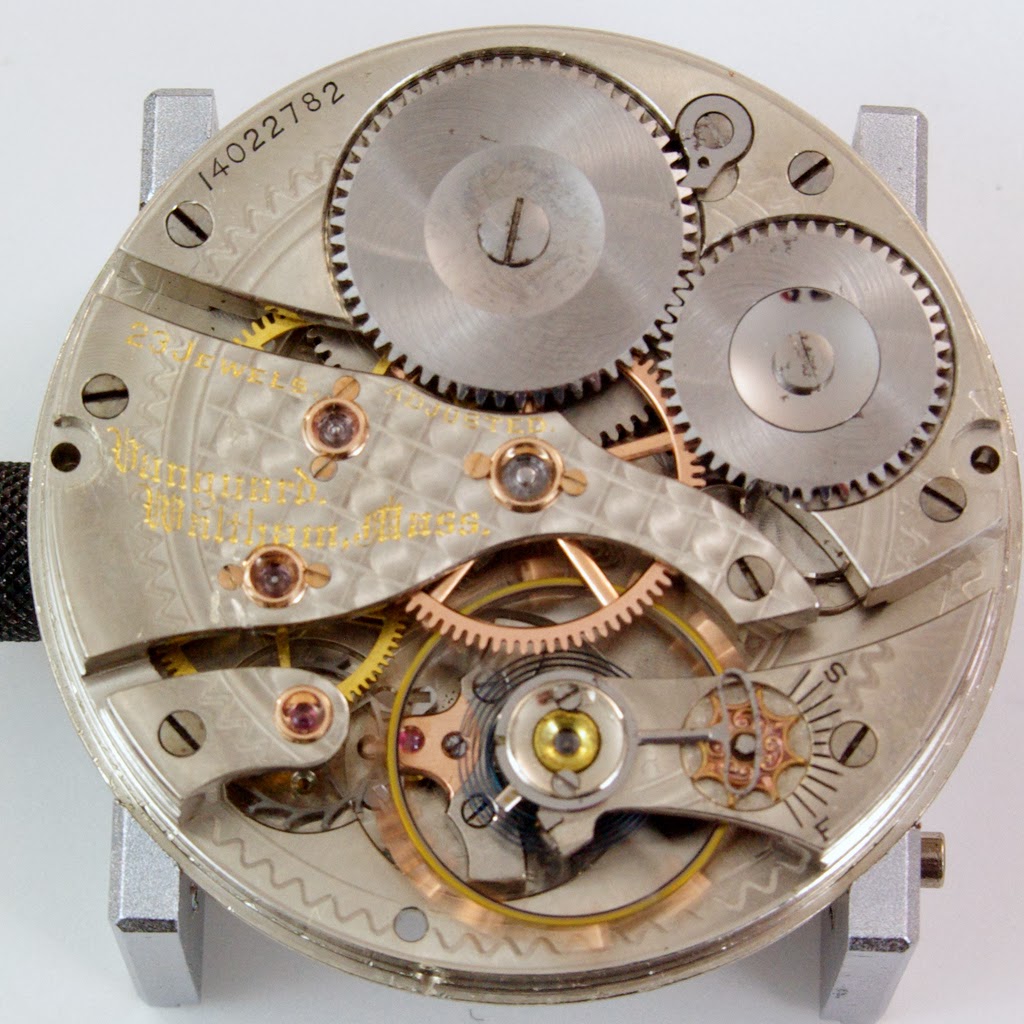
Waltham 1899-Vanguard 23J
click on the images for a larger view
This post was inspired by a query from a customer who was surprised that his newly acquired 23J Waltham 1899-Vanguard featured in my post  anatomy of 1899 vanguard was still running 14 hours after he received it after c24 hours in transit.

Firstly what is isochronism in a watch? In brief it is the ability of a watch to run at the same rate as the mainspring unwinds and that is critical for the accurate running of a watch and is a required "adjustment" in a railroad grade watch. So what has this to do with how long a watch runs?

Most pocket watches are designed to run for 30 hours (some are designed to run for 8 days but I am ignoring those for this discussion), to achieve this the mainspring will have to be of sufficient strength to operate the escapement and to have sufficient length and space in the spring barrel for 30 hours operation.

There is then a major problems to overcome, a mainspring of consistent thickness will provide more power when fully wound than when it is almost run down and although careful design of the escapement can make it less susceptible to varying power input it is unlikely to be completely immune so will run fast when fully wound, slower when partially wound and then faster and less reliably when almost wound down due to a weak (short) balance action.

Historically there have been a number of design features built into a watch to overcome these problems including:
  • An English Fusee movement
    showing the chain drive from the
     Fusee (right) with its spiral path for
    the chain, to the mainspring
    barrel (left) 
    The Fusee chain drive which gave a continuously variable gearing and had a high gear at full wind  reducing linearly to a low gear as it ran down. This meant that the torque delivered to the gear train was more consistent. It also reduced the minimum and maximum power delivered by the spring in the same way as...
  • The Geneva stop gear used by the English and Swiss in the late 19th and early 20th centuries but like the Fusee not adopted by the American industry. This limited the winding of the spring from a pre-tensioned state to four complete turns of the mainspring arbore (not the winding gear). This meant that the mainspring was never at maximum or minimum tension and delivered power in a more linier fashion over a narrower range. But it also limited the run time of a watch, particularly one not in tip-top condition.
  • Introduction of more jewelling to reduce friction requiring less mainspring power (see below) and more accurate fitting of the components to reduce friction and other inefficiencies.
  • In later years, as metallurgy and manufacturing processes improved, mainsprings were made of varying thickness through their length to provide more consistent power as they wound down, this technology was not however effective around the turn of the century when the Waltham 1899 & 1908 models were designed.
So why did the Vanguard run for so long?
Waltham 1899-Vanguard 23J
mainspring & barrel assembly

Highly jewelled variants of a movement can run for long periods because of the low friction enabled by so many jewels and in particular the jewelled spring barrel, this means that a weaker spring than the lower jewelled variant is often used (apart from other reasons the movement may otherwise run too hard and break the impulse jewel). A weaker spring is thinner so can be longer and still fit into the usually optimum outer 33% of the diameter of the barrel before winding. So it runs for longer but time keeping will be affected as it runs down.
But as watches are regulated for 24 hours (with a 30 hours maximum) this is one of the ways Isochronism is managed, if the watch runs for say 40 hours then the pressure exerted by the spring will be more consistent over the first 24 hours than if it only ran for 30. 
So a 23 jewel Waltham Vanguard and similar movements in good condition, with a good escapement and a weak main-spring (perhaps 0.15mm thick in the case in point) of the correct length (25.5") will run for considerably longer than a 7 jewel Traveler with its need for more power to overcome friction and a thicker (0.19mm) and shorter (21.3") spring. And because of the extended run time, the Vanguard over the first 24 hours of running, will not suffer the same reduction of power in the later stages than the Taveler and, even before other design factors come into force, will deliver more constant performance.
Length matters!


Friday, 28 February 2014

Spot the difference - 1899 vs 1908 Vanguard.

1908-Vanguard 23J 1913/14
Top right is a newly restored 1908-Vanguard made in 1913 or 1914, below is the 1899-Vanguard made in 1904 or 1905 shown in detail in a previous post (anatomy of an 1899 Vanguard). Both have 23 jewels so what is the difference?

Well as you can see, not a lot, this particular 1908 model has the better type of regulator but most 1908's have the star macro regulator seen here on the 1899.

The later model also has ruby & sapphire jeweling with diamond end stones to the balance and the 1899 is missing the diamonds but again only a minority of the 1908's had them.

1899-Vanguard 23J 1904/05
In fact a glance at my 1939 edition of the Waltham spares catalogue show only trivial differences (trivial that is if you don't happen to need one of the few variant parts!). JS, a long term collector and correspondent points out that "The fundamental difference between those models is the configuration of the winding crown wheel. The radius of the right-angle gearing is greater (and it is beveled) for the 1908 model, making for easier winding, and less wear, but with more turns."

In fact there were some bigger changes to the 1908 during its extended life time than there are between the 1899 and 1908 models.

So the bottom line is that the model number change was as much a marketing ploy than anything else.

Some things never change.


Friday, 21 February 2014

Anatomy of an 1899-Vanguard part 2.

Waltham 1899-Vanguard, 23J, 1904/5
The Vanguard in the previous post ran stronger and stronger as the oil circulated and things settled down, in fact is was running too strongly and was reaching the point where the balance could swing too far and, particularly if knocked at just the wrong time the impulse jewel could have broken. So a  steel spring has replaced the alloy (which is stronger for its size) and all is now well.

The watch has metal dial which although not perfect is in remarkably good condition for is age - whilst they do not hairline like ceramic dials they can get very shabby.

The case is Filled Gold by Bates & Bacon, owned by Philadelphia Watch Case Co when this case was made.

Now for the next watch, an Omega this time I think.

Thursday, 20 February 2014

Anatomy of an 1899-Vanguard

Face or "Bottom" plate
This is one of a series of posts illustrating the main grades of Waltham size 16 watches, primarily the 1899 & 1908 models. It is not practical to put a huge number of photographs into each post or to illustrate each of the  grades to be covered with more than a couple of pictures so I have taken detailed photographs as I worked on this 23 jewel 1899 Vanguard Railroad grade movement to show what is inside.

Although this is a very high grade watch all of the 1899 & 1908 movements are of the same basic configuration. Click on the image for a much larger picture.

There is not much to say about the bottom plate except to point out the damascening even where you can't see it. Top centre is the winding / setting mechanism controlled by the Lever on the other side.


Mainspring assembly: This grade of watch has jewels to the mainspring arbour, they are housed in in the top of the barrel (shown centre bottom) through which the two part arbor ("axel") passes. The barrel is top left and the spring fits inside it with the geared lid or top, naturally, on top. The whole is kept together by the little screw thingy bottom right going through the barrel and into the other part of the arbour. On lower grade watches the arbor is in one piece and the barrel and top are not secured together directly but held together by the plates of the movement.

Next we have the part of the frame holding the main top jewels plus the bridge that holds the lever pallet. On this high grade movement the jewel settings are gold and the three larger ones are set using screws rather than pressed.

The lever pallet and escape wheel both have cap jewels (bottom left and on the pallet bridge - but they don't show up very well). The engraving on this model has been highlighted with a gold wash.


Having been cleaned the movement is now ready to go back together and the main wheels are "planted" into the face plate, the mainspring barrel has been placed early to show how it fits in.

Note the steel escape wheel on the Swiss lever escapement ( the lowest in the picture). The centre wheel is gold whilst the other wheels are brass.


It takes a little fiddling about, particularly with the escape wheel with its end jewels making for a very shallow hole to get the pivot into but soon we end up with the movement basically back together and the lever pallet can be put in which is another fiddly job.


Almost there now and its time to fit the balance. The Vanguard has gold balance screws which gives a heavier balance and better timekeeping but requiring a stronger hairspring.

The double roller can be seen in the centre on the "axel", the main benefit of the double roller is improved timekeeping when being subjected to the normal bumps it will take whilst being worn.

A second advantage (later not usually taken) is that the roller can be made in two parts one of Bronze and the other steel which allows the impulse jewel (just visible at the bottom of the light brown disk) to be set into the bronze without glue - which is not practical in steel - whilst the rest be the stronger metal needed there.

Monday, 17 February 2014

Three Completed S16 Waltham Watches.

The three movements shown below are now back in their cases.


On the left is the Pendant set 17J 1899-Riverside from 1900/01. The Three piece dial (see previous post) is signed by Fattorini & Sons  Watch & Chronometer Manufacturers, Bradford, Fattotini are still in business as makers of insignia, medals and trophies (they made the FA cup among others), their dials come up on occasion buy rarely do you see these nice three piece dials on a size 16 Waltham.

The middle watch is a railroad grade 21 Jewel 1908-Crescent St, it has an uncommon (for a lever set watch) hinged front so it is more convenient and quicker to set than a watch with a screw on bezel. The three piece dial is a US railroad approved type.

On the right is a 23J 1908 Vanguard from 1935/6 and shortly after this one was made the movement was changed loosing the nice screw set jewels in their gold mounts (see this post below), the dial is typical of these later watches.

Sunday, 16 February 2014

Three size 16 Waltham movements.


Some work in process, three good Waltham movements all of which have nice Gold plated cases now being cleaned. From left to right (click the image for a larger view):

1899-Riverside, 17J, Pendant set, 1900/01.
1908-Crescent St, 21J, Lever set, 1926/27.
1908-Vanguard, 23J, Lever set, 1935/36.

The Riverside has a particularly interesting dial, watch this space! Also coming soon will be an illustrated review of all of the commonly available size 16 movements by Waltham.

Tuesday, 4 February 2014

Progress?

Here we have two Waltham 1908 23j Vanguards, both are size 16 Rail Road Grade movements so will have had similar superior performance when manufactured. 

The on the left is from 1907 and has extensive damascening, gold mounted screw set jewels that are mainly ruby plus diamond end jewels on the balance.

 
The one on the right has machine pressed synthetic jewels and is from 1940.

Sunday, 19 January 2014

Waltham 1892 Vanguard, 21J, 1903


Another nice Railroad Grade Waltham 1892 Vanguard, this one with 21 ruby and diamond Jewels is from 1903 and has a Canadian railroad dial. It is in a quite rare 14 carat Filled Gold case by Fahys that was guaranteed to "wear permanently" that was only made between 1902 and c 1904.

Sunday, 5 January 2014

Waltham 1892-Vanguard, 23J Railroad Watch, 1908.


Jewels are Ruby, Diamond and probably sapphire for the pallet jewels, full railroad grade with a good case. The dial is a "Montgomery", made in three pieces and with the number 6 printed in... full as it should be, these dials are valuable in themselves, one in this condition is currently on the market for $150 + carriage and import charges.

These 1892 watches are selling like hot cakes with 5 going to repeat customers in the last couple of weeks. And with this quality it is easy to see why.

Sunday, 22 December 2013

Three of the best


From left to right.

Waltham 1892-Crescent St, 1904, Size 18, 21 jewels and adjusted to heat, cold, isochronism and 5 positions, lever set and a true US Railroad watch.

Waltham 1908-Vanguard, 1913, Size 16, 23 jewels (Ruby plus a diamond end stones), adjusted to heat, cold, isochronism and 5 positions, lever set and another true US Railroad watch.

Waltham 1892-Vanguard, 1900, Size 18, 21 Jewels (mainly ruby), adjusted to heat, cold, isochronism and 5 positions, pendant set and with roman numerals on the face so not a true railroad watch, but close. In a filled gold case.

Friday, 20 December 2013

Waltham 1908-Vanguard 23J


I don't normally photograph work in process but I thought I would make an exception for this one; A Waltham 1908-Vanguard from 1913/14, it is a lever set movement with 23 jewels (including the mainspring) and is adjusted to heat, cold, isochronism and 5 positions. And as you can see it has nice gold embellishments and damascening all over the place.

As is often found with these railroad grade watches the case is in base metal but it should still look good when finished.