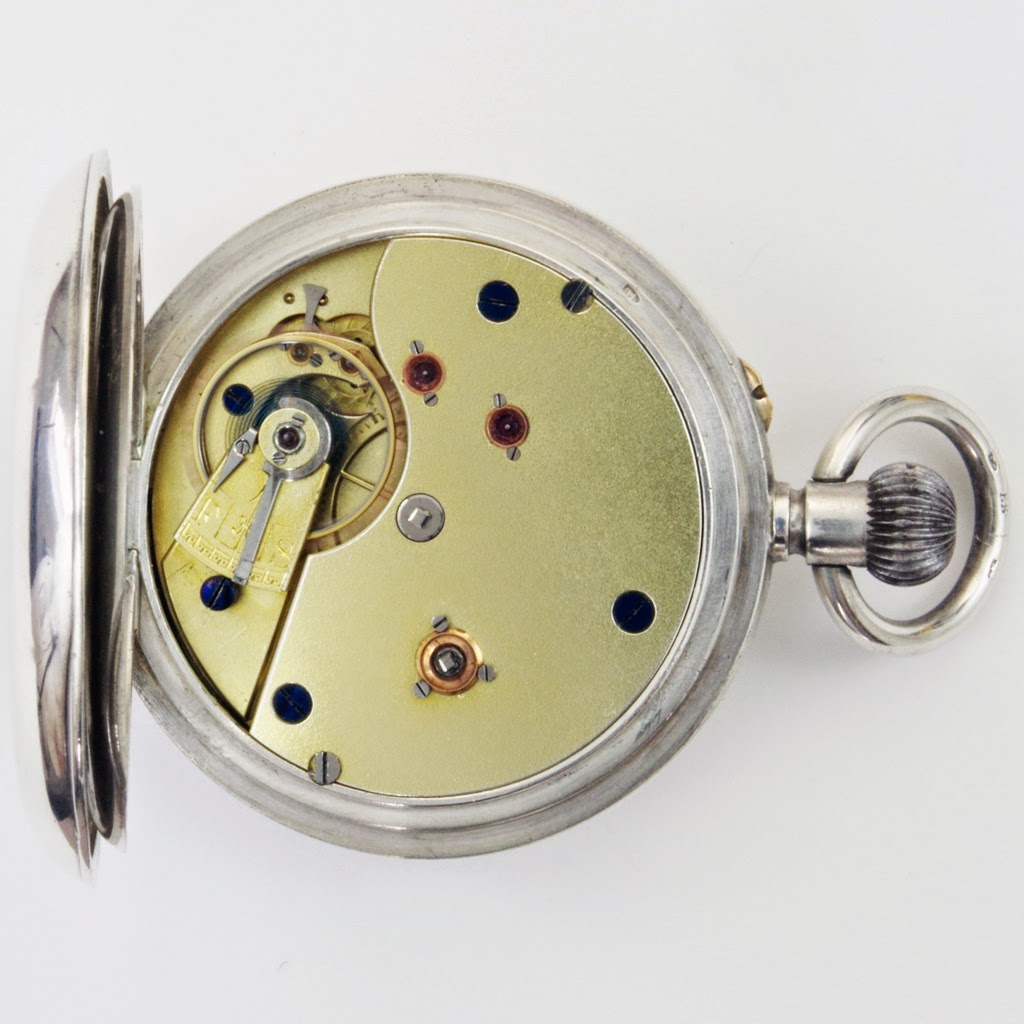
Showing posts with label Rotherham. Show all posts

Sunday, 31 March 2019

Rotherham Serial Numbers

Two Rotherham 19J watches from 1910, one size 12 the other size 16.

The two watches above both have the classic 19J three-quarter plate pin set movement by Rotherham, one in size 12 the other size 16. Both are from 1910 and coincidentally I acquired them on the same day from different sellers. One interesting point is the difference in serial numbers.


The size 12 is number 293,062.

The size 16 is number 148,956.

The reason is that Rotherhams used multiple serial number ranges, I don't know how many but at least the two shown by these examples, one for size 0 and 6[i] , at least one for earlies models and probably more. This makes it difficult to determine the companies total production which Cutmore[i] estimates at about 600,000 in total over 50 years. It can also make dating watches in filled gold cases tricky if the movement is an unusual size.


[i] Watches 1850 – 1980 M. Cutmore, David & Charles, 1989


The size 16


Sunday, 20 January 2019

An unusual jewel configuration on a 17J Recta.

This 17 jewel Recta for J.W. Benson  has an interesting configuration in that the centre wheel does not have a jewel on the face side and the jewel count is made up to 17 with a single cap jewel on the escape.

English makers, particularly Rotherham, Errington and Coventry makers using CWM Co ebauchés did something similar either making 16 jewel movements or adding one centre wheel jewel to their 19J movements probably under presure from Marketing department to have a jewel visible on the centre wheel.

20 Jewel Rotherham, 1903.

The designers did not want a jewel at the face plate as with the centre wheel only turning once per hour the benefit is small and with the power from the barrel being applied close to the face plate there is a percieved risk of damage.


A 16 Jewel Errington 1906

Friday, 17 February 2017

Rotherham Three-quarter plate keyless watches.

Open Faced (left) and Hunter (right) 19 Jewel Rotherham three-quarter plate
movements. All that I have had have had the curved top plate, but other
makers used a similar shape so that alone is not a guarantee it is a Rotherham.
Introduced in the very (?) late 1880s the elegant Rotherham three-quarter plate movement remained in production with minimal changes until the company stopped watch production in the mid-1930s.  
 
Under the dial view showing the Rotherham logo (Centre right) and the
rocking bar setting mechanism. the general layout is the same as Rotherham's
Keyless Full plate model of the 1890's and into the next century.

The majority that I seen[1] are from 1890 through to WWI with a few from the 1920s. The earliest dateable one I have seen was from 1890 and the latest, for J.W. Benson, was in a case hallmarked 1934.

An 11 Jewel Size 6 half Hunter for Rowell of Oxford. 1891.
The movement was made in many sizes from zero through to size 16 and initially at least, with many combinations of jewels including 11J, 13J & 19J.

Rotherham did not favour jewelling the centre wheel for reasons explained in another post and would go for cap jewels on the escape before jeweling the 3rd wheel and often before jeweling the fourth or the lever pallet as they did in the 11J example for Rowell shown on the right.

As time went on the lower jewel count movements became far fewer and the odd movement begins to turn up with 20 jewels.
From my sample, by far the most popular was the size 12 with 19 jewels.


A rare 19J size 0 Rotherham 3/4 plate, 1907; the only significant difference with the larger models is the
lack of a seconds hand, it even has Geneva stop work. The case is 1.5" in diameter excluding the pendant etc.

The 20 Jewel version, 1902. Very unusually it
is marked as adjusted.
All of the movements had true English Lever escapements many had Geneva stop gear and this was retained on the 19 & 20 jewel models  until well after WWI.

Almost all had steel Breguet hairsprings with cut compensating balances but a few were produced with Elenvar Breguet springs with solid gold balances. 

It is likely that the many, if not all, of the 19 & 20 jewel movements were half-chronometers but  although print advertising often made much of this it was not the custom to mark English movements as "adjusted" and only a few later models I have seen were so marked.

The most common Rotherham three-quarter plate, a size 12 19J.
This one for Reid & Son of Newcastle upon Tyne. It is now back
with a descendant of the retailer, the result of a long search!
Cases were mainly silver and solid gold, the former at least made in house, the later were much less substantial and “frequently swing out” types”, I have not seen enough of these to even guess at who made them.

A typical Silver Half-Hunter case, this one a 19J size 12 for Butt & Co
branded "The County". 1911
Filled gold cases are seen from time to time, early ones are simply marked 14K Filled Gold, later ones are fully marked by Dennison as their 14 carat Filled Gold “Sun” grade. I suspect all of the filled gold cases were bought in but have no real evidence to support that.

A Hunter in a 14 Carat Filled gold
"SUN" grade case by Dennison c1929.
Rotherham supplied a lot of the smaller 19J movements to J.W. Benson and like about 80% of Rotherham’s production the only Rotherham mark is hidden under the dial.

A fairly rare variant of the standard movement was made for dress watches, this was slimmed down by about a third compared with the standard model and had a clip on dial.


The slim variant of the 19J Size 12 in a
14 carat solid gold case, 1932.

A centre seconds variant was also produced but I have seen very few and had only one, these where not chronographs having no stop function.


A rare centre seconds variant with 20 Jewels for
retailer W.J. Storey, 1894.


 [1] I have seen just over 80 Rotherham ¾ plates from size zero through 16, some are datable, others not.

Wednesday, 27 July 2016

Why 16 & 19 Jewels on English Watches but few with 17?

A 16 jewel movement by Errington of Coventry.
Several quality English makers made 15, 16, 19 & 20 jewelled watches but rarely, if ever,  used 17 or 21. The first reason to spring to mind might be cost, there may be some truth in that but I think the real reasons are the very conservative nature of most English watch makers and alternative and maker preferred methods of adding jewels.

Jewels are used because they are hard wearing and smooth so the pivot hole does not go out of round and friction is reduced, if only some wheels are to be jewelled it is best to use them on wheels that are moving quickly and with gearing effects have the most impact on reducing the overall power requirement of the watch.

The basic 7 jewels on a lever watch are 2 hole jewels + 2 cap (or end) jewels (to reduce end float and to keep the shoulders of the pivot off of the jewel to reduce friction) for the balance, an impulse jewel on the roller and 2 on the lever pallet. After this the next pair of jewels would normally be put on the escape wheel. After that there is some disagreement as to where they should go, the options being:
  1. On the lever.
  2. On the seconds wheel.
  3. As cap jewels on the escape.
An 11 Jewel movement by Rotherham
with hole and cap jewels on the
escape wheel.
Some makers go for option 1 although the lever does not go through 360 degrees which is why some go for option 2. Rotherham in particular will go for option 3 to further reduce friction and to increase stability at this critical point, this may also be a cheaper option.

After 11, additional jewels would normally be added in pairs moving towards the centre wheel until you get to 15 (or 19 for a Rotherham with cap jewels on the escape and lever).

At this point it is worth mentioning that the marketing men sometimes prevail over the watch makers and jewels were added just on the top plate where they can be seen and not on the face plate. This is waste of jewels as those on the slower turning wheels contribute little and the benefit of the jewels that are there is reduced. I see this quite frequently on Swiss watches for the English market and occasionally on American watches.

English watchmakers did not like putting jewels on the centre wheel, this is probably a legacy of very strong main springs in big movements and a concern that the pressure would break the jewel. When pressed a lot of makers, notably Errington, would put a centre wheel jewel just on the top plate where it would be seen and not on the face plate where the maximum pressure from the barrel would normally be.

A rare 20 jewel watch by
Rotherham of Coventry.
Rotherham and many of the better Coventry makers would go to 19 by putting cap jewels on the lever and the escape, ignoring the centre wheel (they did not advertise the fact by engraving the movement as having 19 jewels so to the uninitiated they look like 15 jewel movements). Some excellent movements were made this way.  If pushed to show a jewel on the centre wheel they would then follow the practice of adding a single jewel to end up with a 20 jewel watch but these are rare birds.

In American makers would make a 19J watch by jewelling all wheels and then either adding cap jewels to the escape or jewels to the barrel, something not seen on English watches.


Thursday, 15 October 2015

A Rare Rotherham and a bit about hairspings & balances.

A Size 12 Rotherham for Hoefler &
Co of Devenport. 19 Jewels, 1901.
This is at first sight a normal high end size 12 Rotherham with 19 jewels but two things make it unusual, first is still has an original watch paper in the back as described in my last post, but more important is the very rare balance assembly.

Normally these movements have a cut compensating balance with a normal steel Breguet hairspring, however in the late 1890's a new alloy known as "Elenvar" was devised by Charles Édouard Guillaume (who got the 1920 Nobel prize for physics for the development), its key property was that unlike steel its flexibility (modulus of elasticity) did not change with temperature. When used as a hairspring it removed the need for a compensating balance.

A very rare solid balance with an
Elenvar Breguet hairspring.
Most companies implemented the Elenvar hairspring with a screwed balance which allowed the balance to be balanced fairly quickly (as a car wheel with a new tyre) and the weight and number of screws could be used to adjust the moment of inertia to match the hairspring to make the watch run too time. 
 
With this movement Rotherham tried a different route and used a traditional 3 armed solid balance which is probably gold. Balancing and tuning was done by removing slight amounts of material from the balance as can be seen from the picture to the right..

This is the only watch I have seen with this arrangement and it is likely that Rotherham only made a few, probably because the amount of skilled work required to set up the balance would more than likely have made it more expensive than the normally sprung cut compensating balance.

Wednesday, 14 October 2015

A rare pair of papers.

click the picture for a larger view
It is very rare these days to find watches with watch papers intact (they are collectable in their own right), I had only 2 or 3 from the last 600 watches. And today two turned up together, I knew one was coming but the second was a nice surprise.
 
The papers were used for advertising and would have been put in by sellers or repairers and occasionally you find a watch with a stack of them but usually they are glued together, to the case and / or are falling to pieces. Both of these are original to the watch and have the same retailers names as are shown on the watch faces.
 
The blue one is on a Rotherham from 1901 retailed by Hoefler of Devonport. The watch itself is something rather special - watch this space!

The red paper is on a Waltham 1908-610 half hunter sold by Harral of Barnsley, it has the serial number of the movement on it and is dated 11 years after the watch was made so presumably they were warranting a repair or they had bought back the watch and had resold it.

Wednesday, 8 April 2015

Imitation is the sincerest form of flattery: A Swiss 17J Half Hunter c 1897.


But in the case of this Swiss watch the unknown maker should have been more confident and signed the watch. It  is the best made and finished Swiss watch I have come across, better I think than the Labrador by Louis Brandt and Frère / Omega  and at least as good as the early Rotherham it rather looks like. (Sorry Coventry Watch Museum  J also on Facebook ).

The movement was clearly made for the English market having the classic Rotherham shape, Fast and Slow markings without the French equivalent (A & R) and a true English Lever Escapement. It has 17 jewels, 15 plus cap jewels on the escape, and they are all screw set on the top  and three are on the face plate.
The Breguet sprung cut compensating balance has, apart from the timing screws which are steel to  gives finer control of the timing, gold screws which is not common in a Swiss watch. It also has a double roller and a functioning Geneva gear to control mainspring pressure.
The setting gear is particularly impressive with every piece very well finished.
 

Saturday, 7 March 2015

A 19J Rotherham from 1902/3 signed and presented by the company.

I continue to get in some very good watches by Rotherham and in the last six months have had more than in each of the previous 2 years. 

This one is particularly interesting as it was not only signed "Rotherhams, Coventry & London" it has engraved on the dust cover:

"Rotherhams' Swimming Club, Coventry, 120 yds. Open Handicap Sep. 19. 1904. 1st Prize. Won by F. Burre".

Sunday, 2 November 2014

Coventry made "Own Label" watches

Rotherham 19J 1903 keyless branded
"Time O Day"
by Russell of Liverpool
After an exchange of Facebook messages and posts with the Coventry Watch Museum I have been doing an analysis of the watches I have handed recently to see how many Coventry watches were signed by a third party. I looked at three of the large Coventry makers - Rotherham, Errington / Williamson and Wm Ehrhardt  who although based in Birmingham is normally considered to be part of the Coventry trade.

The analysis will understate the number signed by third parties because although many are signed on the movement and/or dial many are signed only on the dial and as explained in my blog post "Why the blank faces? some of these will have been done using a fragile transfer print process which over time can be lost.

 This is what I came up with:

Total # 3rd party signed
Rotherham 70 69%
Errington 44 73%
Ehrhardt 24 63%

I suspect that the Ehrhardt percentage would have been at least as high as the others originally but they produced a cheaper watch which was more likely to have a transfer printed dial signature than a more expensive enamelled version, for this reason and the sheer numbers involved I have excluded from the Errington sample  the Williamson 1905, 1910 and other late model which were widely sold under other names.

It is also revealing that apart from J.W. Benson there are very few "repeaters" in the list with most of the names being small local companies, indicating that, as I expected, relabeling Rotherham and other Coventry made watches was a widespread practice.

Saturday, 18 October 2014

Hunter vs Open Faced construction:


You may think it is a trivial change to turn an Open Faced watch to a Hunter by just changing the position of the winder. However on a keyless watch there is normally rather more to it as these photo's of Rotherham 19 jewel movements from 1896 demonstrate. Although many of the internal components are the same (if the watches are the same size) you can see that the Hunter on the right is a near mirror image of the open faced on the left.

Saturday, 23 August 2014

The Riddle of the Hands (with appologies to Erskine Childers)

Rotherham key wound and set
full plate watch, Coventry, 1903.
This post is prompted by another query as to why a watch with gold main hands has a blue second hand, Carruthers  may have been able to find an answer but I can't and nor can others I have asked.

Swiss watches with gold hands normally have all three gold whereas most English watches such as this Rotherham, which was made in the year that Riddle of the Sands was published, does not.

The same will be found on English cased Waltham watches as most found in the UK are. Plain, rather than filigree,  gold hands were I am told rare in America and do not appear in my copy of the Waltham parts catalogue, so it is likely that hands were sourced and fitted locally conforming to English practice, which fits with a common method of selling these watches as described in my post on the standard watch case.

I think it will remain one of life's little mysteries.

Thursday, 29 May 2014

May Market update.

There was a sudden rush of good English watches in the second half of the month supplemented by a few watches from one of the big auction houses (the 20% buyers premium  hurts!).

Unfortunately quality did no always match quantity with several being scrapped or put to one side in the probably vain hope that spares will become available. Still 9 English watches, finished in a month (including the just finished 17J Rotherham from 1894 pictured) is probably a record and there are a few more on the way.

Particularly annoying were a Benson Ludgate and an Errington 16J (several of those this month!) which both had the impulse jewels replace with a metal pin, this kept the watch running but not well and it causes damage to the roller and frequently to the lever pallet so those have both had to be put away, the Ludgate joining 5 others in the same state - its long impulse jewel being particularly vulnerable.

Strangely the number of mid to good quality watches by Waltham such as the 1908-620 (a favourite of mine) has been in very short supply but hopefully that will change.

Saturday, 10 May 2014

Rotherham, 19J Keyless, 1891 - But did they make it all?

This is the earliest size 12, 19J Rotherham I have seen, it is not signed by them but the serial number matches that of the case which carries their hallmark and the date code for 1891/2 which is consistent with Rotherham serial number on watches I have seen from this period. The top plate is typically Rotherham and is shown on the right.

But when the dial is removed the bottom plate turns out to be in two pieces which is typical of the smaller makers in Coventry who were using ebauché (kits of parts) from the Coventry Watch Movement Company.

 If you compare the pictures below you can see that these two are the same apart from:
  • The fixing of the winding and setting gears and
  • The left having 15 Jewels and the right 19 jewels - note the 4 extra screws on the lever and escape jewels on the right hand movement bottom right, these are securing the end jewels whilst with the movement on the left you can just see the end of the pivots which the end jewels hide, click the image for a larger view.
But the one on the left is signed on the plate by Newsome.

Tuesday, 22 April 2014

Size 12, 19J Rotherham.


English watches are still in very short supply but the few I am getting in are rather good.

This is another classic size 12, 19 Jewel Pin set Rotherham  and Sons of Coventry, it has a true English Lever escapement with a Breguet sprung cut compensating balance.

It is signed under the dial by Rotherham and on the movement:

Phillips
Maker to the Admiralty
4 Tinsbury Pavement LONDON


Friday, 11 April 2014

A cracking English watch By Rotherham.

I rarely buy in solid gold watches at auction as they are impossible to value accurately without close examination and are very high risk but I suspected this was by Rotherham and I was right!

It is a fairly rare survivor because although for such a premium English movement a reasonable number were made to be sold into the trade (particularly to J.W. Benson), a large number have been broken up for scrap, mainly I suspect because as a size 12 they were popular in a solid gold case such as this.

 Despite being made in 1925 it is a true English Lever and has 19 jewels.

A classic English watch.


Saturday, 7 December 2013

Rotherham 19J 3/4 plate, 1907

A Yank, then a Swiss now one of Coventy's finest. A Rotherham 19J 3/4 plate keyless for J.J. Dadd & Sons of Hackney, 1907.